
Add CRM event
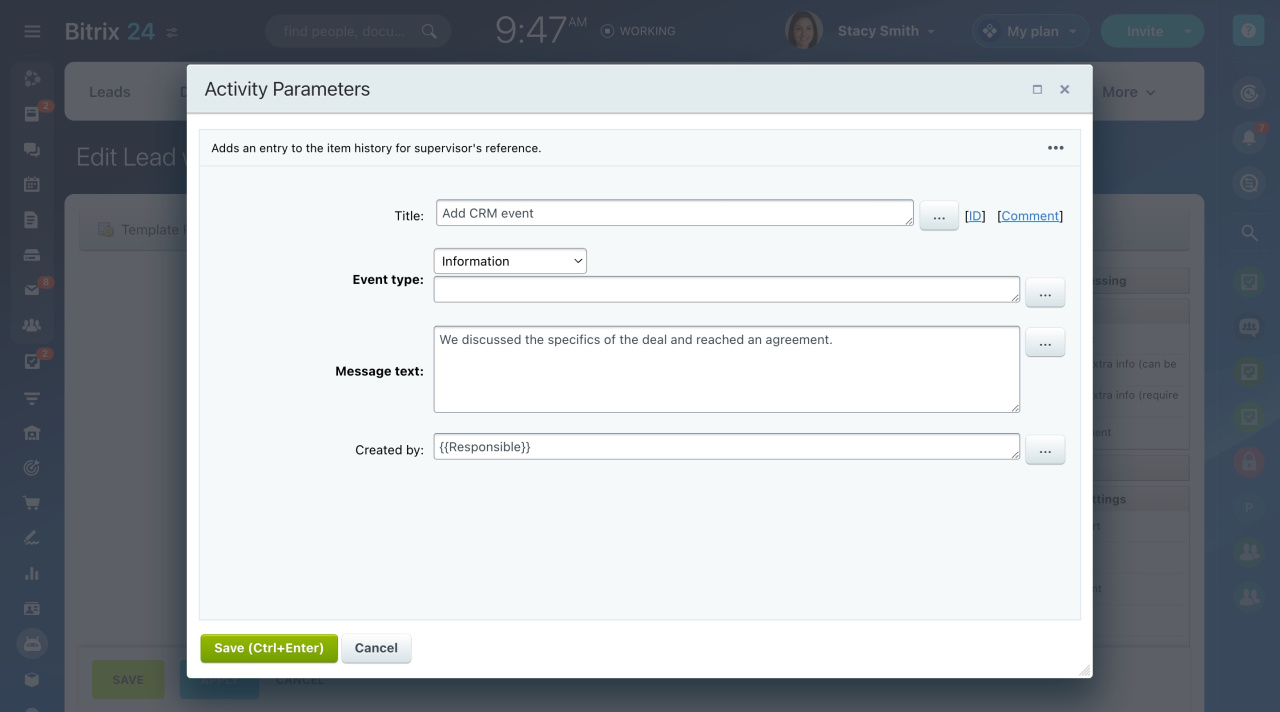
Adds an event to the History tab of the CRM item form.
CRM item form
-
Event type: Choose a type (Information, Phone call, or Email sent).
-
Message text: Enter the text that will appear in the Description field in the History tab.
-
Created by: Select the user who the event is created on behalf of.
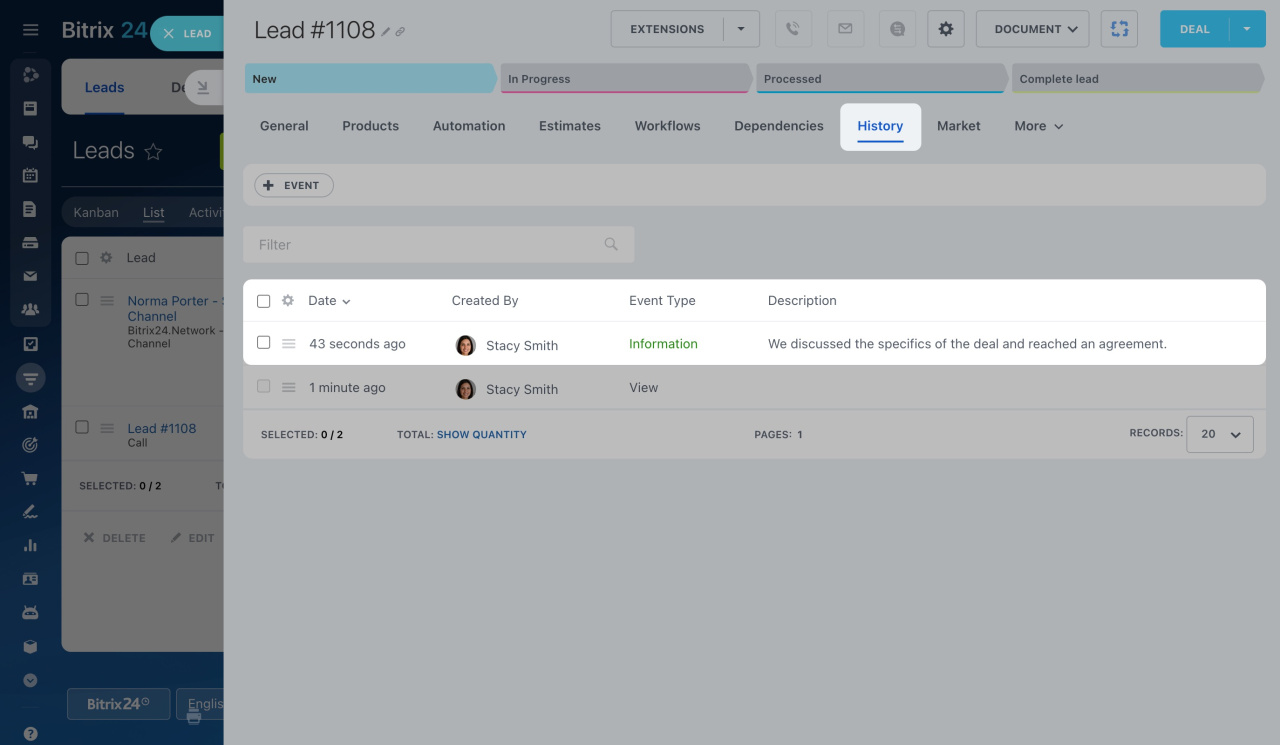
When the workflow runs, the event appears in the History tab.
Add comment to item
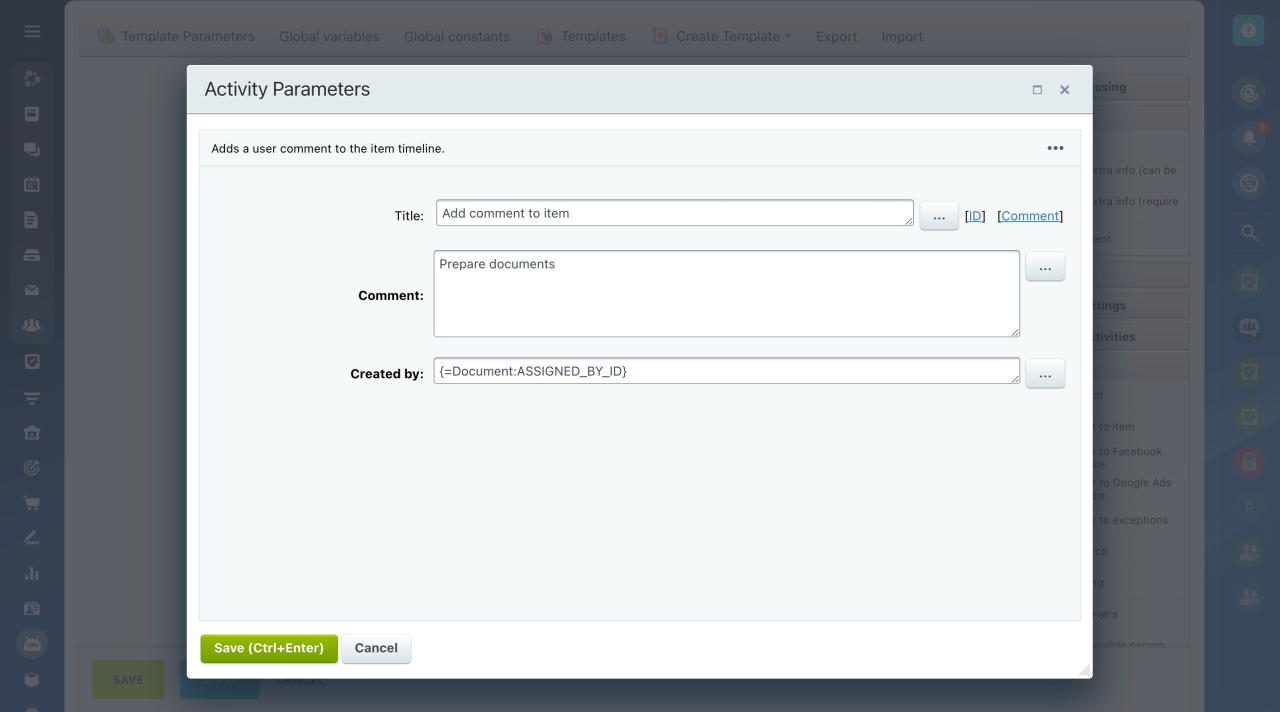
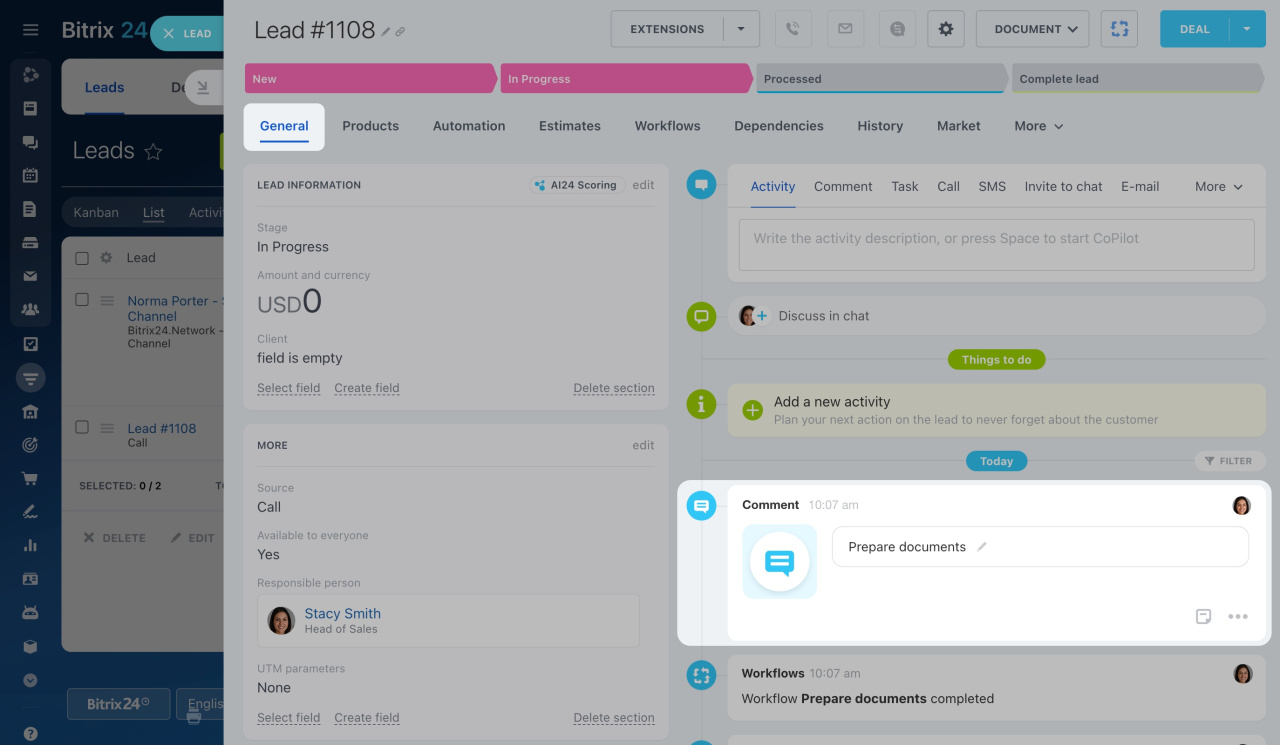
Adds a comment to the CRM timeline.
-
Comment: Enter the comment text. You can use BBCode tags:
[b],[i],[s],[u], and[url].
How to use BBCode tags -
Created by: Select the user who the comment is posted on behalf of.
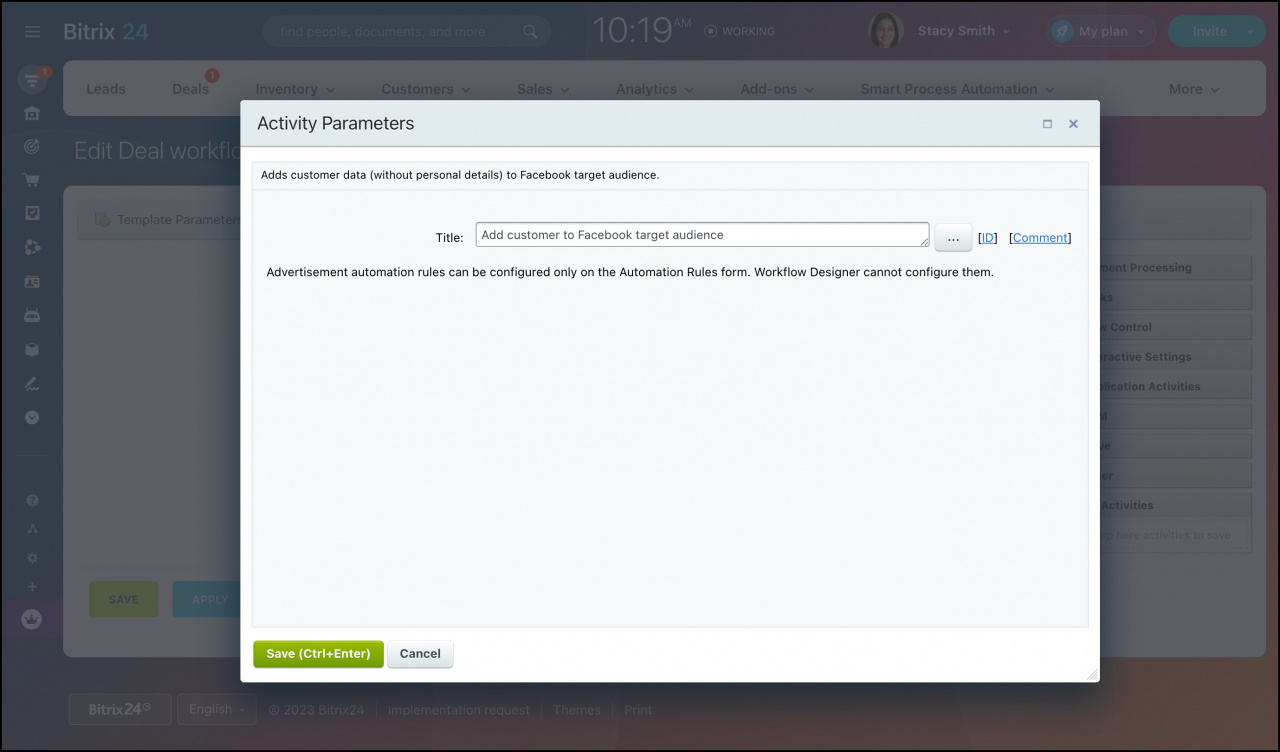
Add customer to Facebook target audience
Adds a customer’s email and phone number to a Facebook audience.
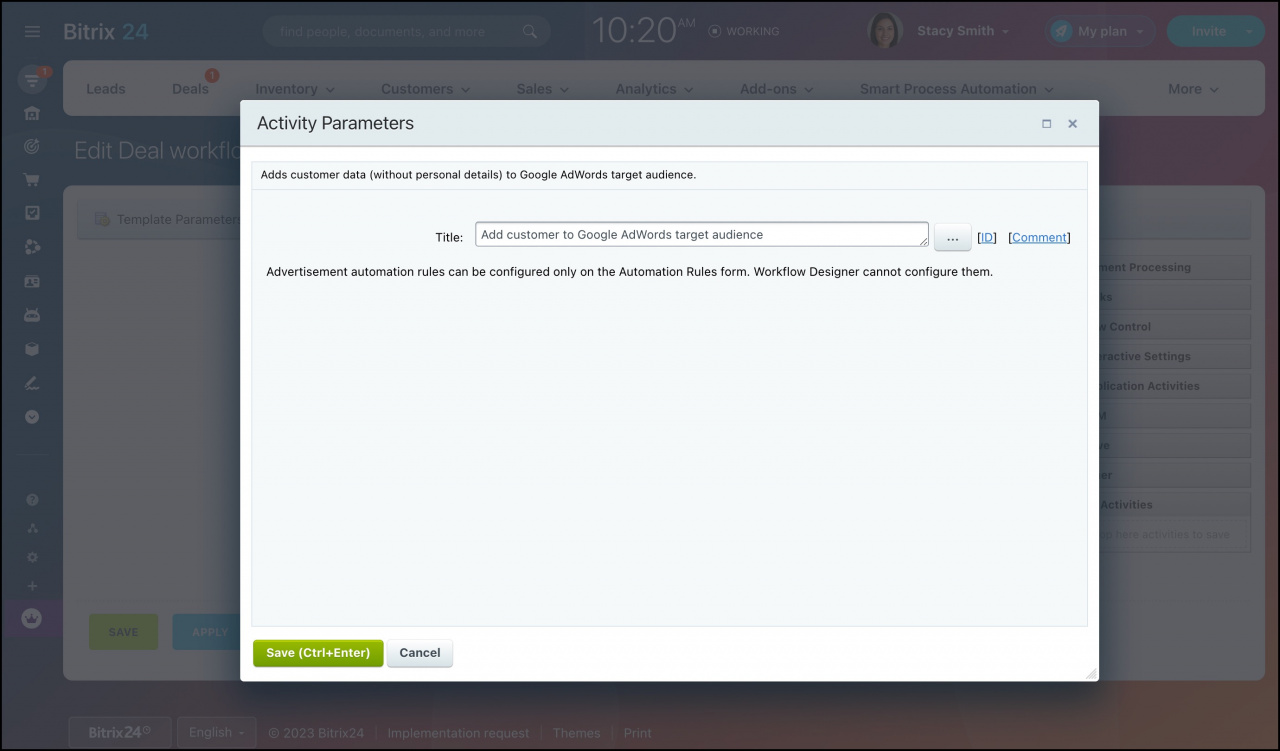
Add customer to Google AdWords target audience
Adds a customer’s email and phone number to a Google Ads audience.
Add to exceptions
Adds the current item to the exceptions list.
Exceptions
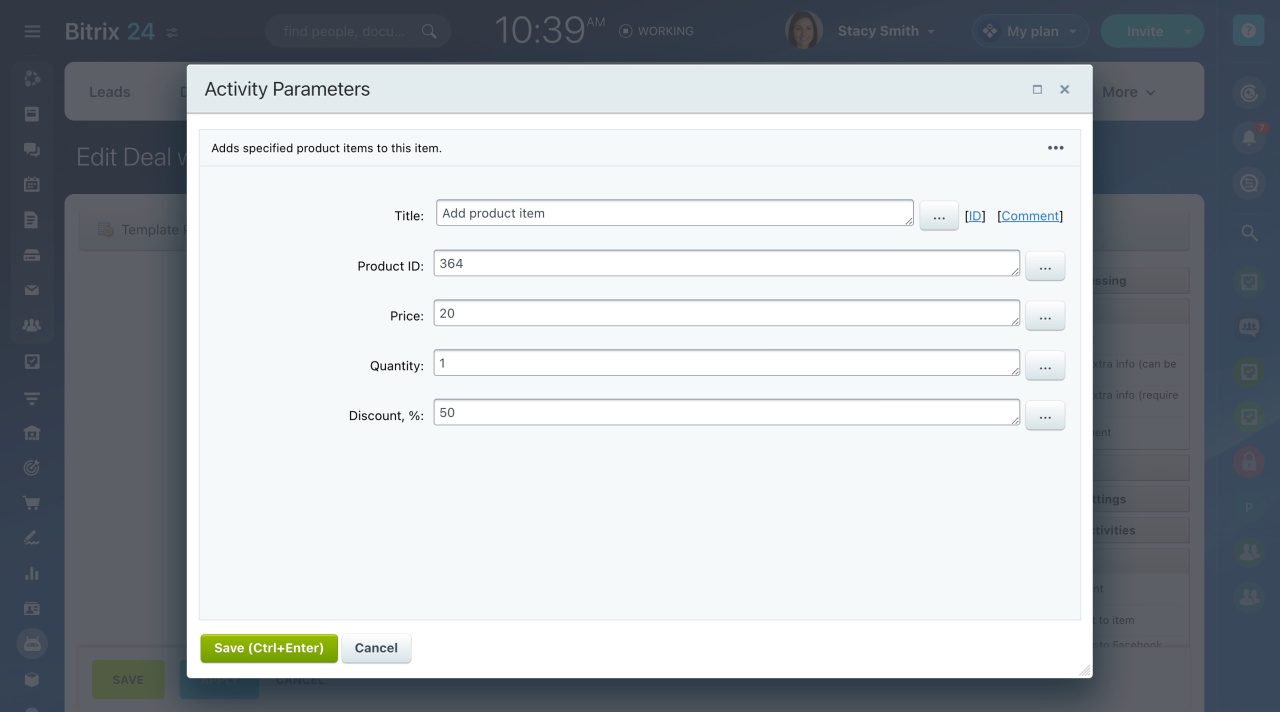
Add product
Adds a product to a CRM item.
-
Product ID: Select a product or enter its ID.
-
Price: Enter the price.
-
Quantity: Enter the quantity.
-
Discount, %: Add a discount if needed.
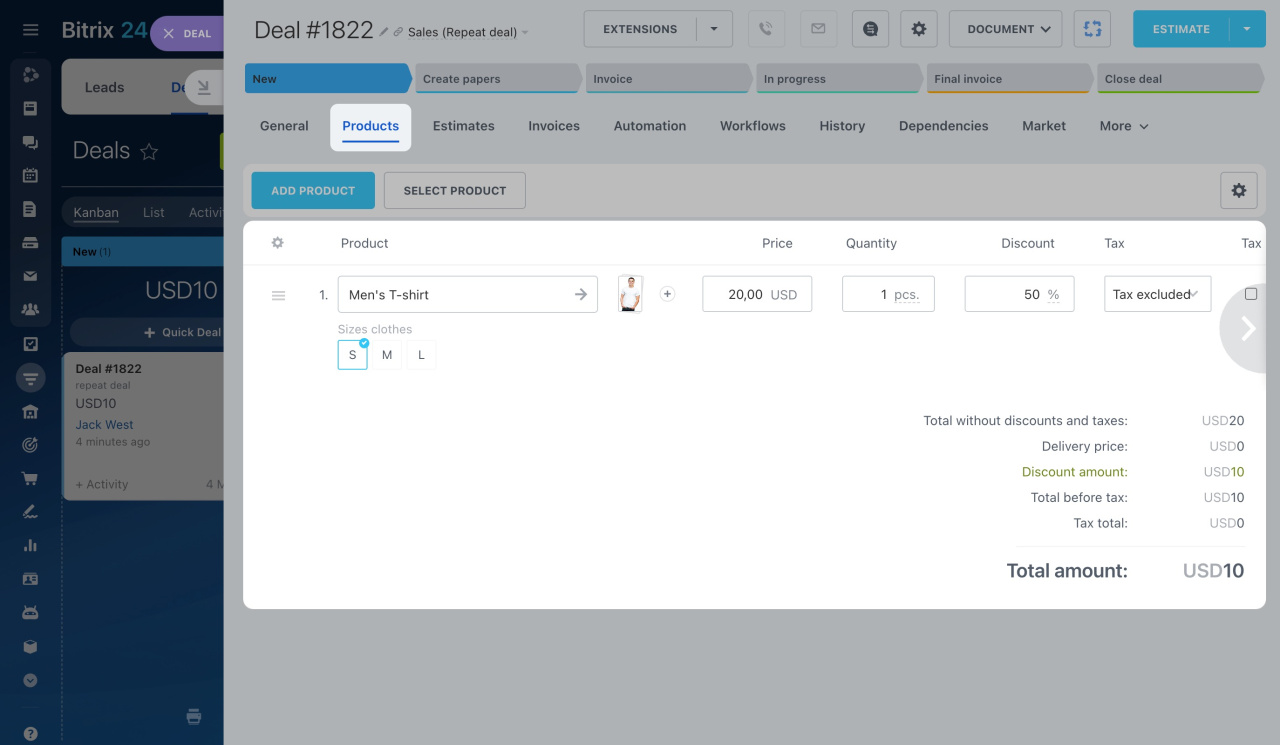
For example, you can add a product to a deal using this activity.
Book a resource
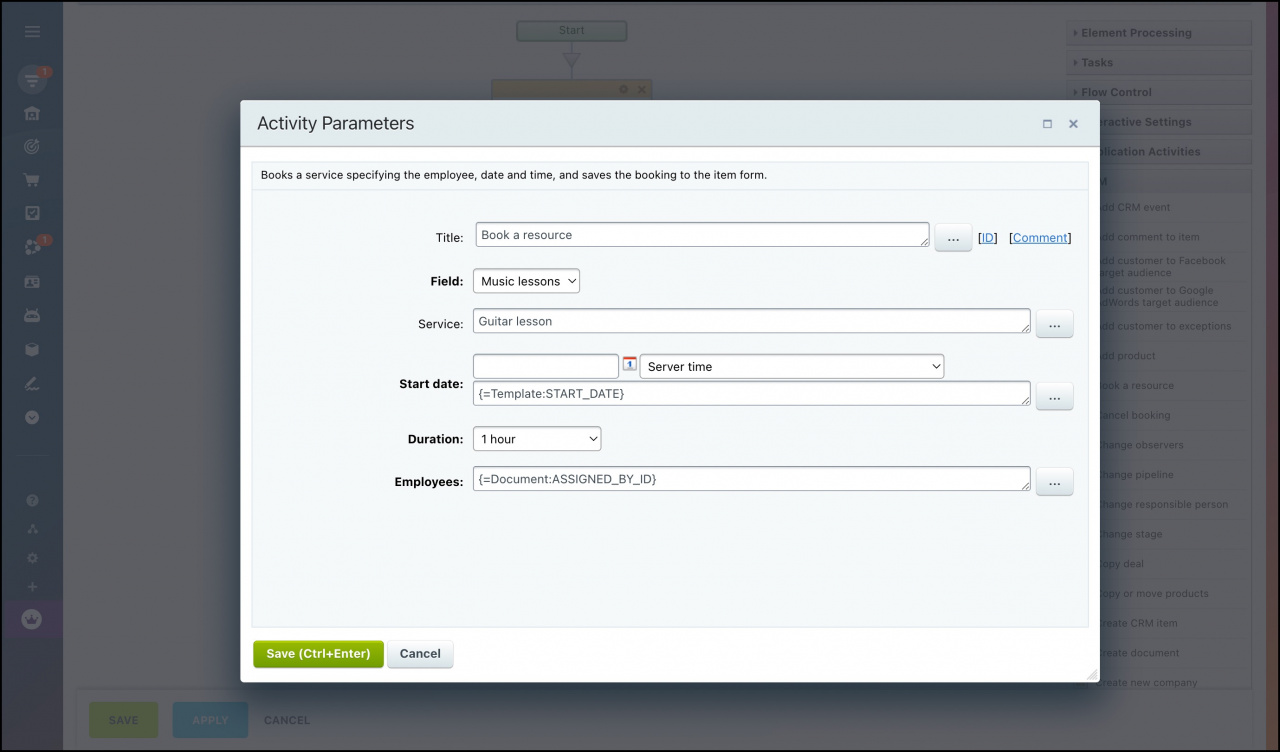
Reserves a resource. You must first add a Book a Resource field to a lead or deal.
Resource booking: how to manage bookings in CRM
-
Field: Select a booking field.
-
Service: Choose the service to book.
-
Start date: Set the date and time. You can add it through the Insert Value form or choose a specific date in a pop-up calendar.
-
Duration: Set how long the service lasts.
-
Employees: Assign responsible users.
Cancel booking
Cancels a booking in a selected Book a Resource field.
Resource booking: how to manage bookings in CRM
Field: Select the booking field.
Change observers
Updates observers in a lead or deal.
Observers in leads and deals
-
Apply action to observers: Add, replace, or remove observers.
-
Observers: Select users or groups.
Change pipeline
Moves a deal to another pipeline.
Sales pipelines
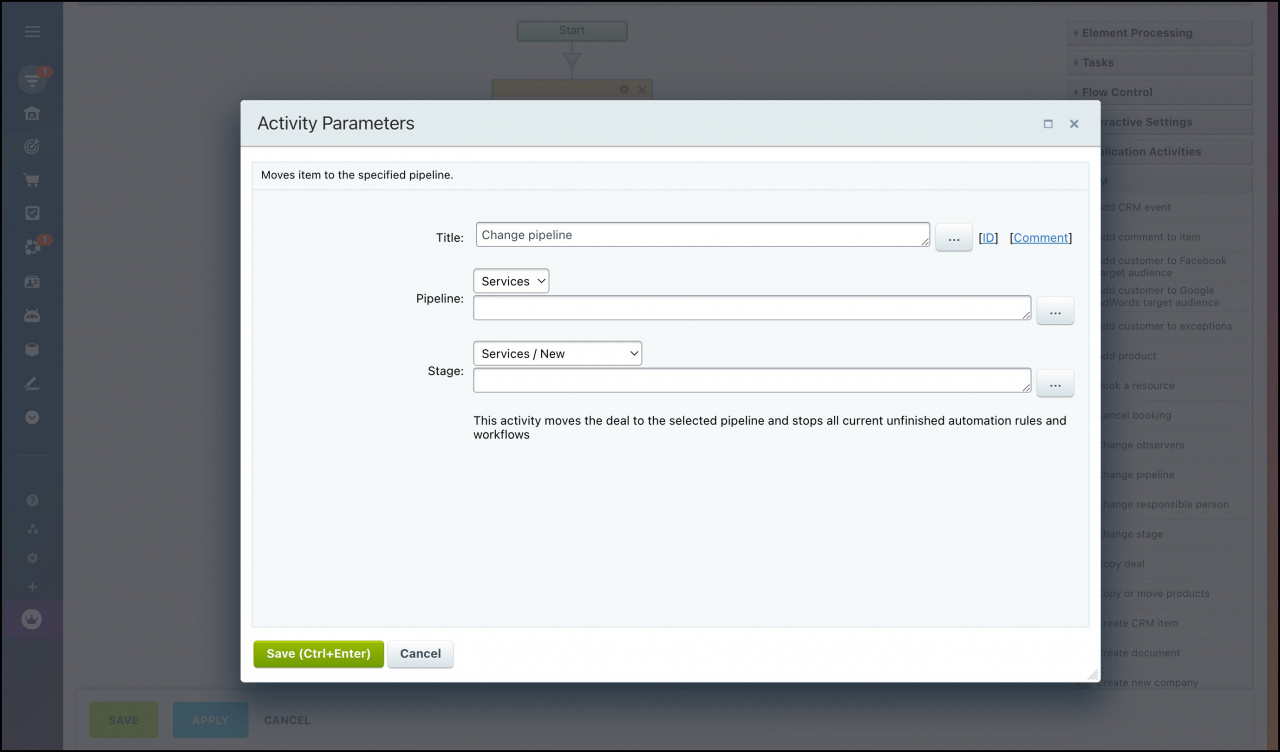
Pipeline: Select a pipeline from the list or through the Insert Value form.
Stage: Choose the stage in that pipeline.
Change responsible person
Assigns a new responsible user.
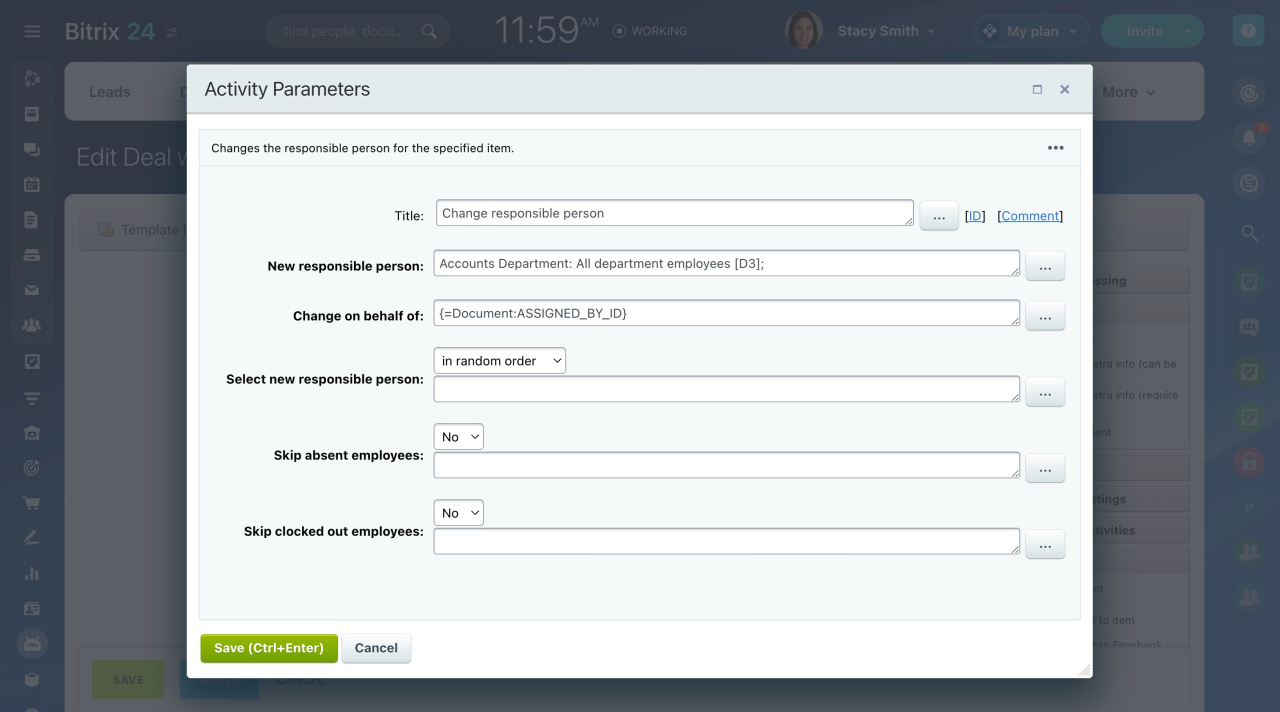
New responsible person: Select a user.
Change on behalf of: SChoose who makes the change.
Select new responsible person:
-
In random order: Picks a random user (excluding the current one).
-
First available: Assigns the next user in the queue.
-
In specified order: Assigns based on a defined list.
Skip absent persons:
-
Yes: Leads and deals will not be assigned to employees marked as absent. The system will assign the next employee in the queue or choose one at random, based on the Select new responsible person setting.
-
No: The system may assign leads and deals to employees even if they are marked as absent.
Change stage
Moves a lead or deal to a new stage.
New stage: Select the stage.
Copy deal
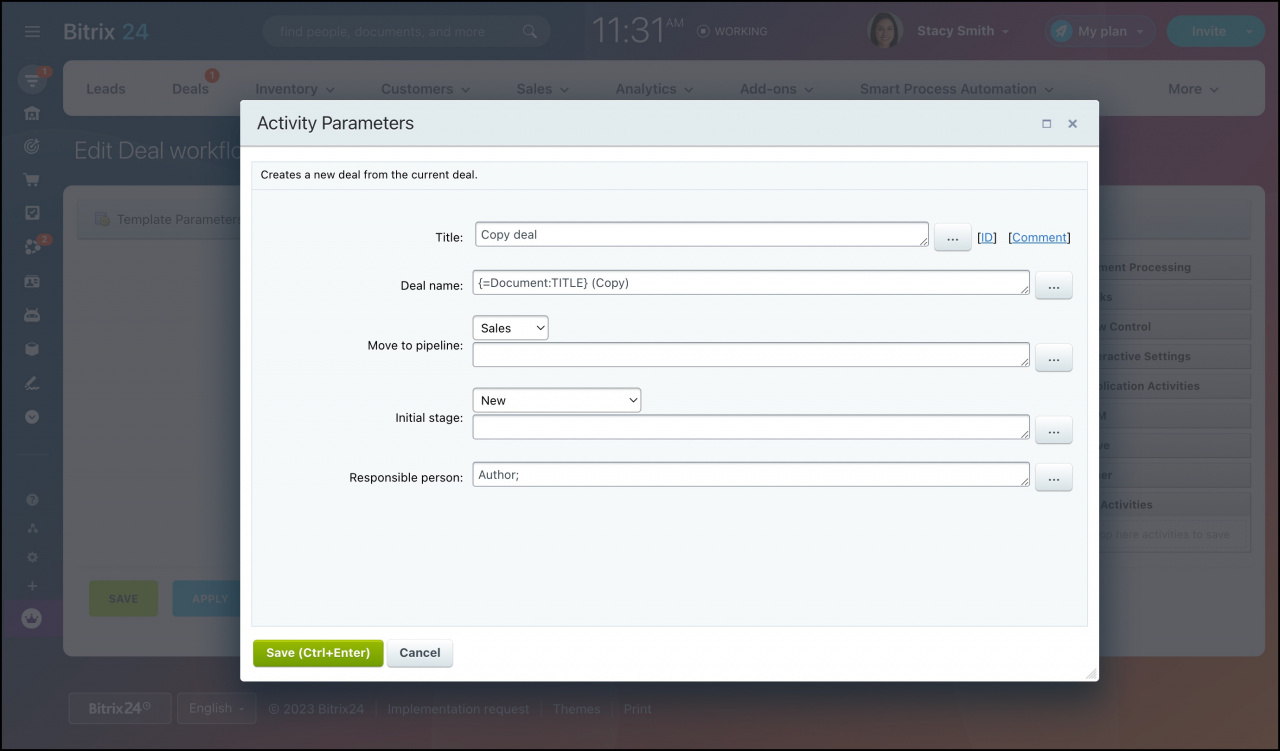
Creates a new deal based on the current one.
-
Deal name: Enter the name. By default, it uses the current name
=Document:TITLEwith(Copy). -
Move to pipeline: Select a pipeline from the list or through the Insert Value form.
-
Initial stage: Set the starting stage.
-
Responsible person: Assign a user.
Copy or move products
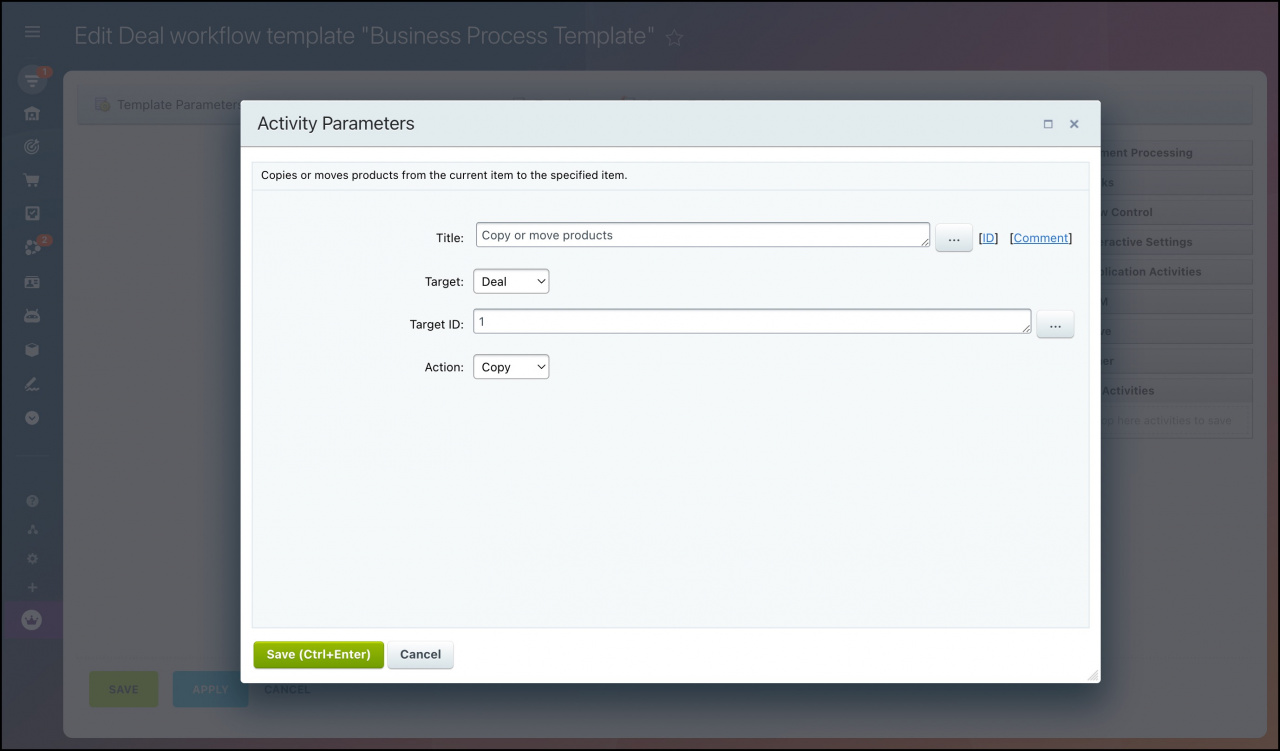
Copies or moves products to another CRM item.
-
Target: Select the CRM item type.
-
Target ID: Enter the destination item ID.
-
Action: Choose copy or move.
Create CRM item
Creates a new CRM item and fills in selected fields.
Create SPA
Creates a new Smart Process Automation item.
Create contact for lead
Creates a contact from a lead and marks the lead as repeat.
Repeat leads
Responsible person: Assign a user.
Create document
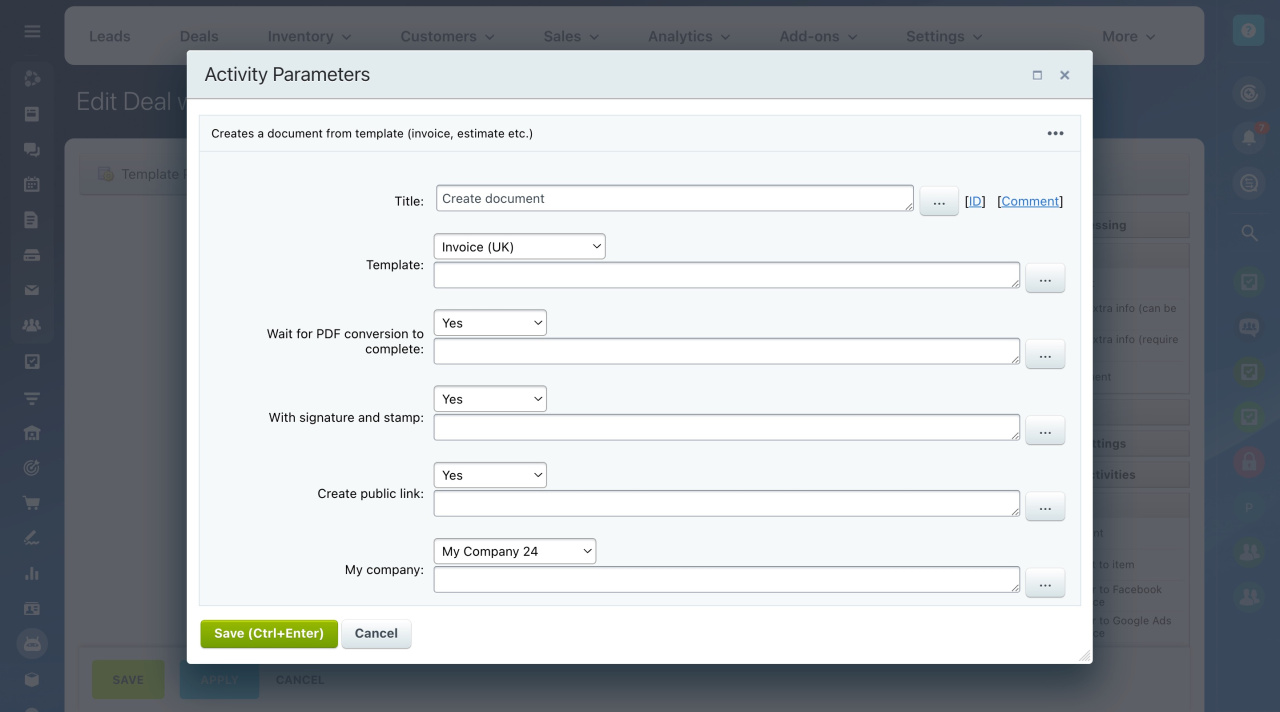
Generates a document from a template and fills in data automatically. To add a variable value, click the three dots (...) and select it.
Documents in CRM: Create and send to customers
-
Template: Select a template.
-
Wait for PDF conversion to complete: If Yes, the activity waits until the file is converted.
-
With signature and stamp: Add if configured.
-
Create public link: Create a download link.
-
My company: Select your company.
-
My company details: Select your company details.
-
My company bank details: Select the bank details.
Under Document Fields, click Add Field to add custom fields.
Create new company
Creates a company record.
Add a new company to CRM
Create new contact
Creates a contact record.
Add new contacts
Create new deal
Creates a deal.
Add a new deal
Create new lead
Creates a lead.
Create a lead
Create payment link
Generates a payment link for an order.
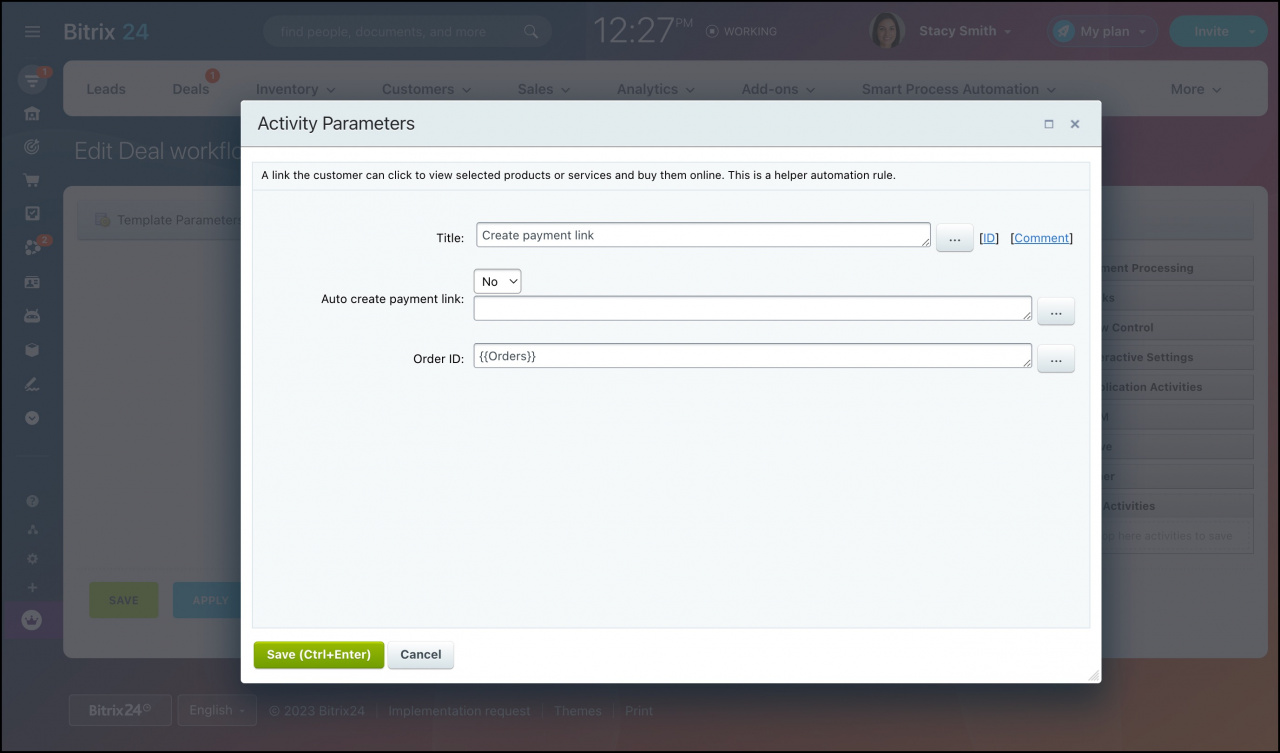
Order ID: Enter the order ID.
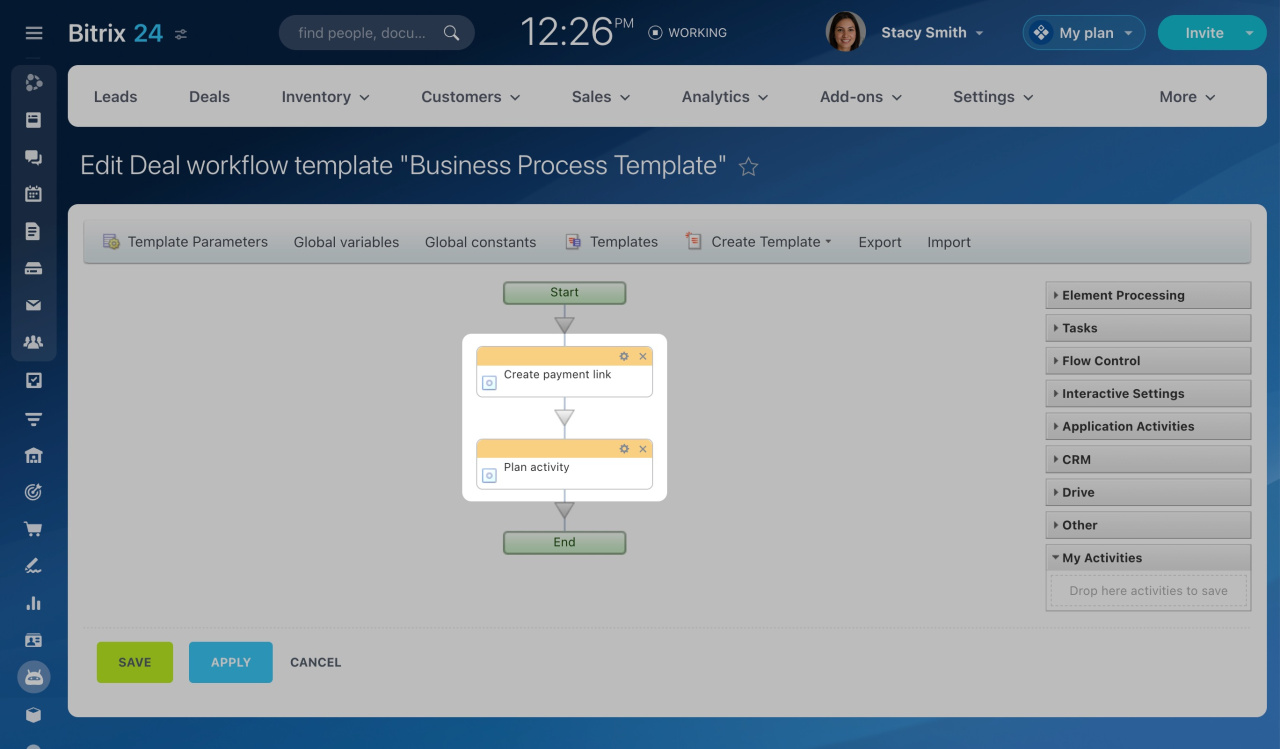
Example
- In the Create payment link action, enter the
{{Orders}}parameter. - Use the Insert Value form to add the generated link to a Plan activity step.
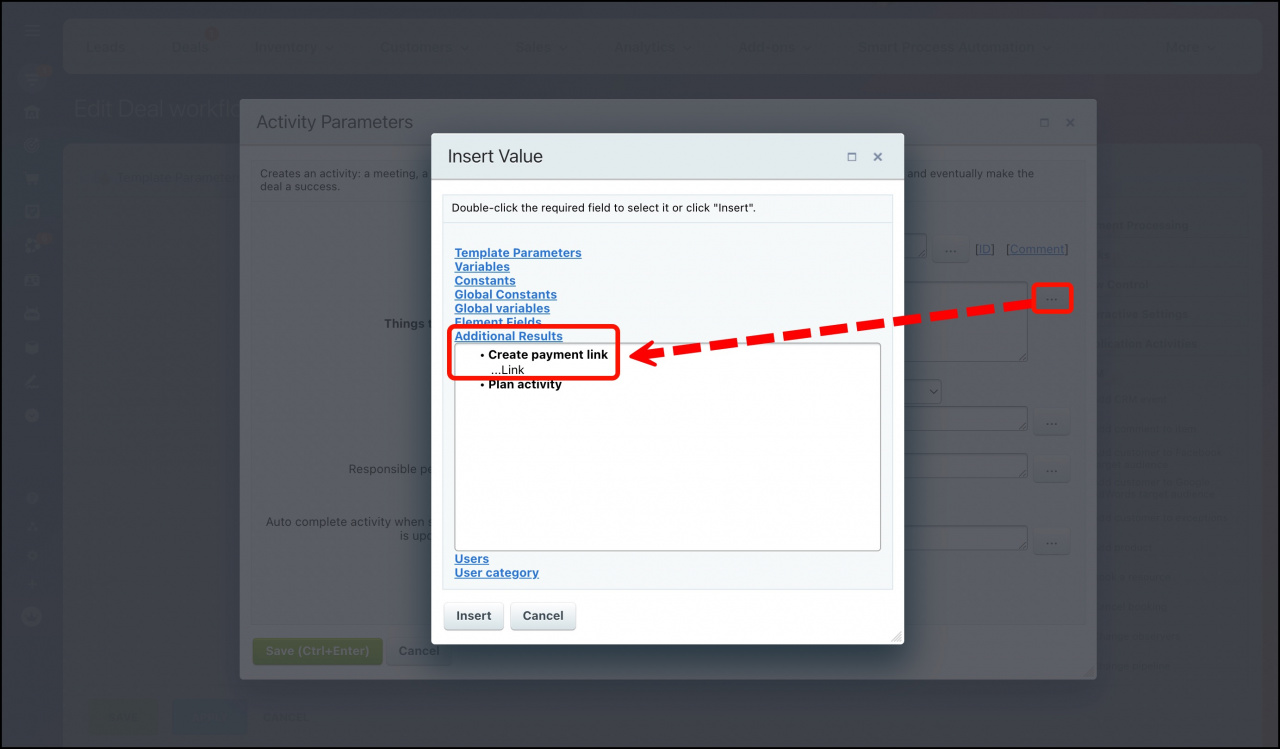
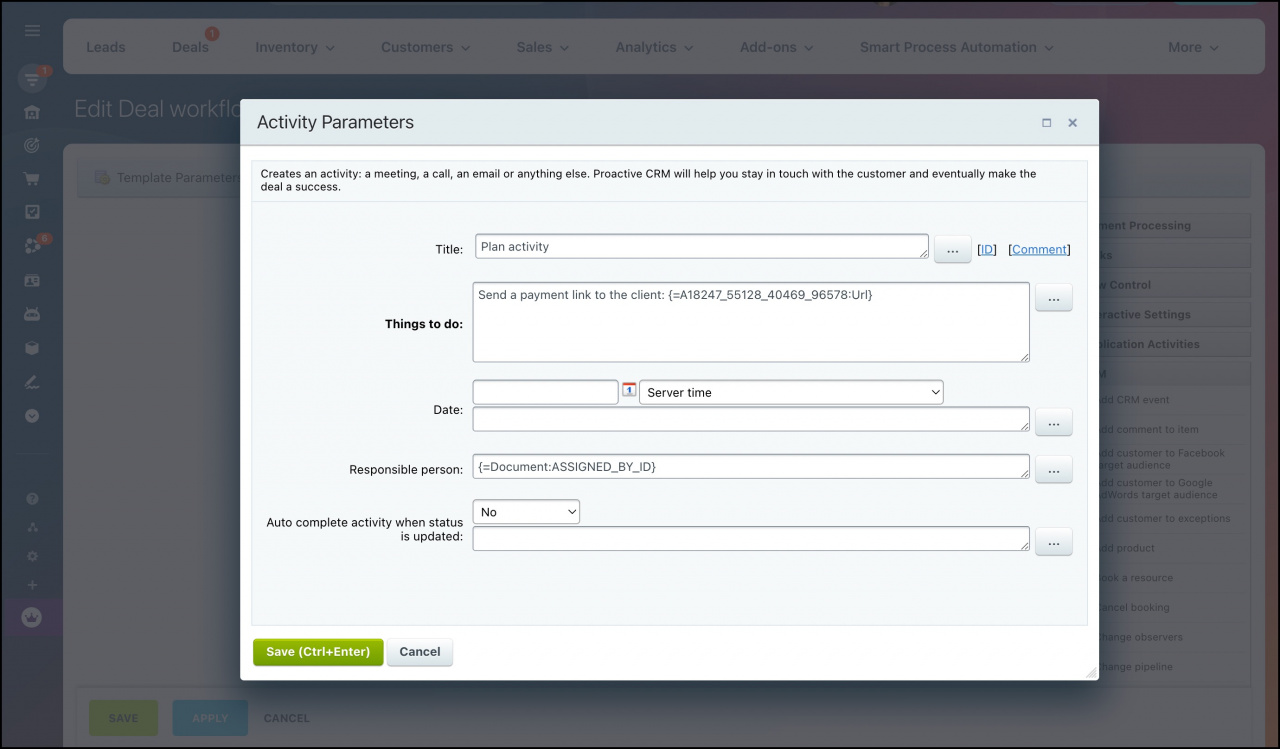
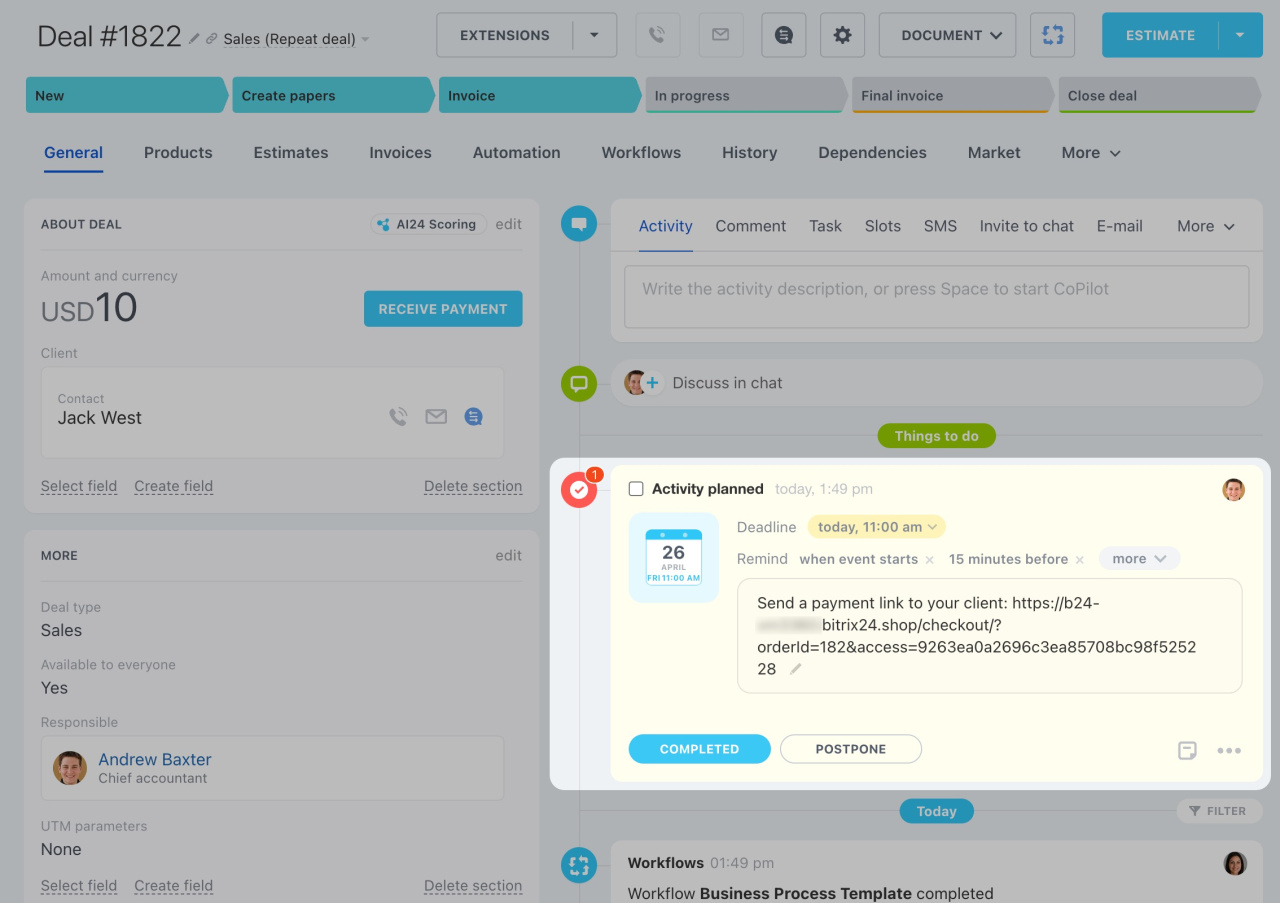
After the workflow runs, the system creates a CRM activity with the payment link in the deal form.
Create repeat lead
Creates a new lead marked as repeat (deal workflows only).
Repeat leads
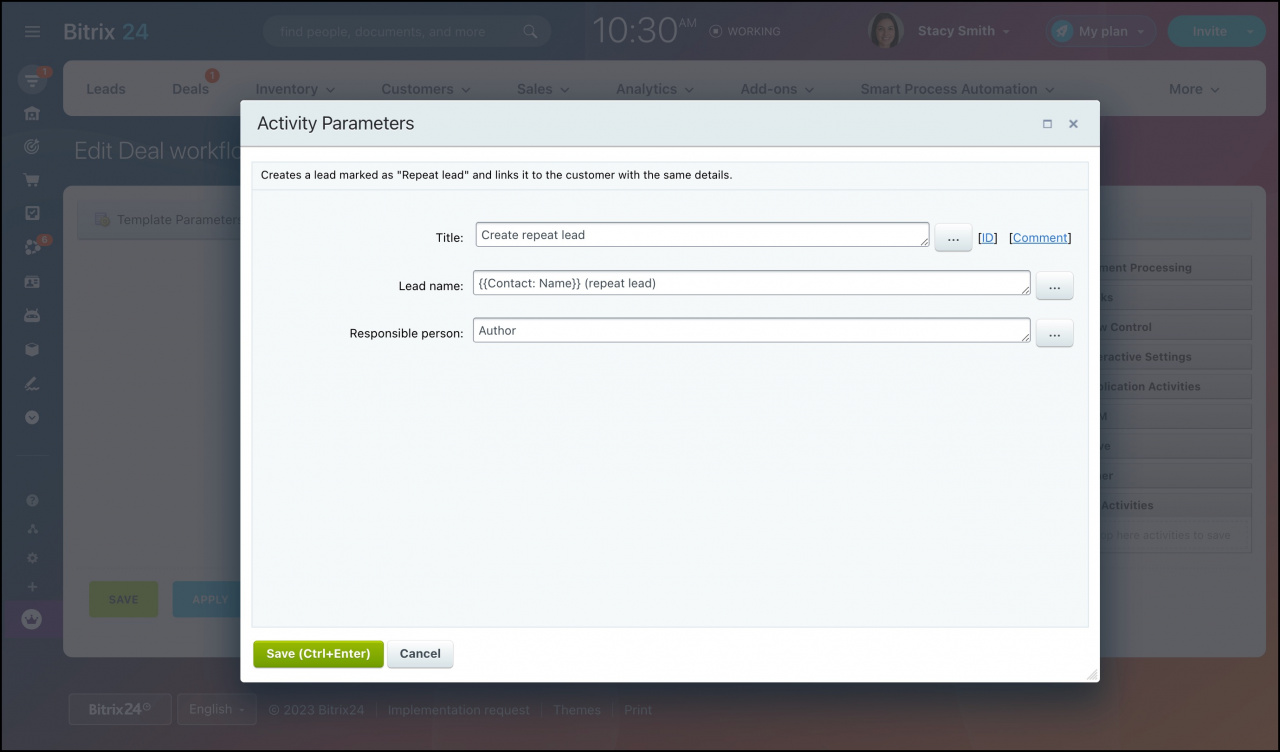
Lead name: Enter a name.
Responsible person: Assign a user.
Create using source
For lead workflow templates:
Creates a deal, contact, or company from a lead (similar to conversion).
Convert a lead
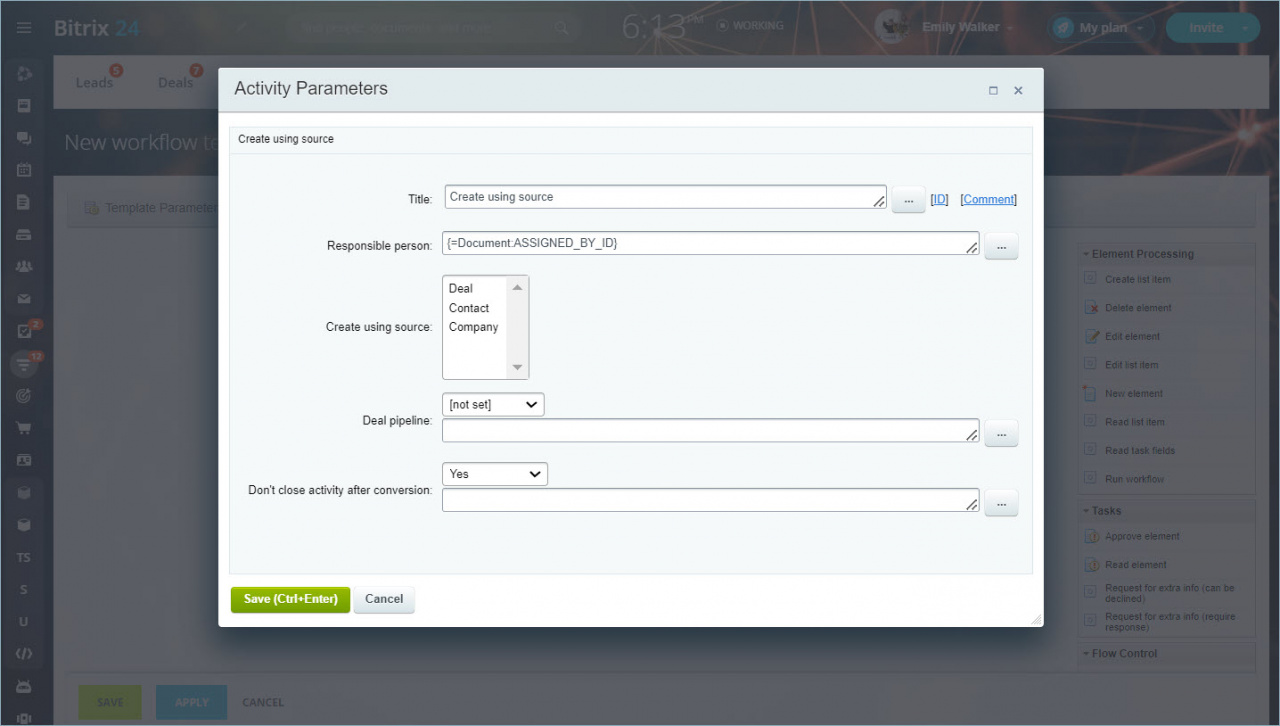
-
Responsible person: Assign a user.
-
Create using source: Choose what to create.
-
Deal pipeline: Select a deal pipeline (if needed).
-
Don't close activity after conversion: Prevents closing related activities.
For deal workflow templates:
Creates an invoice or estimate using existing data.
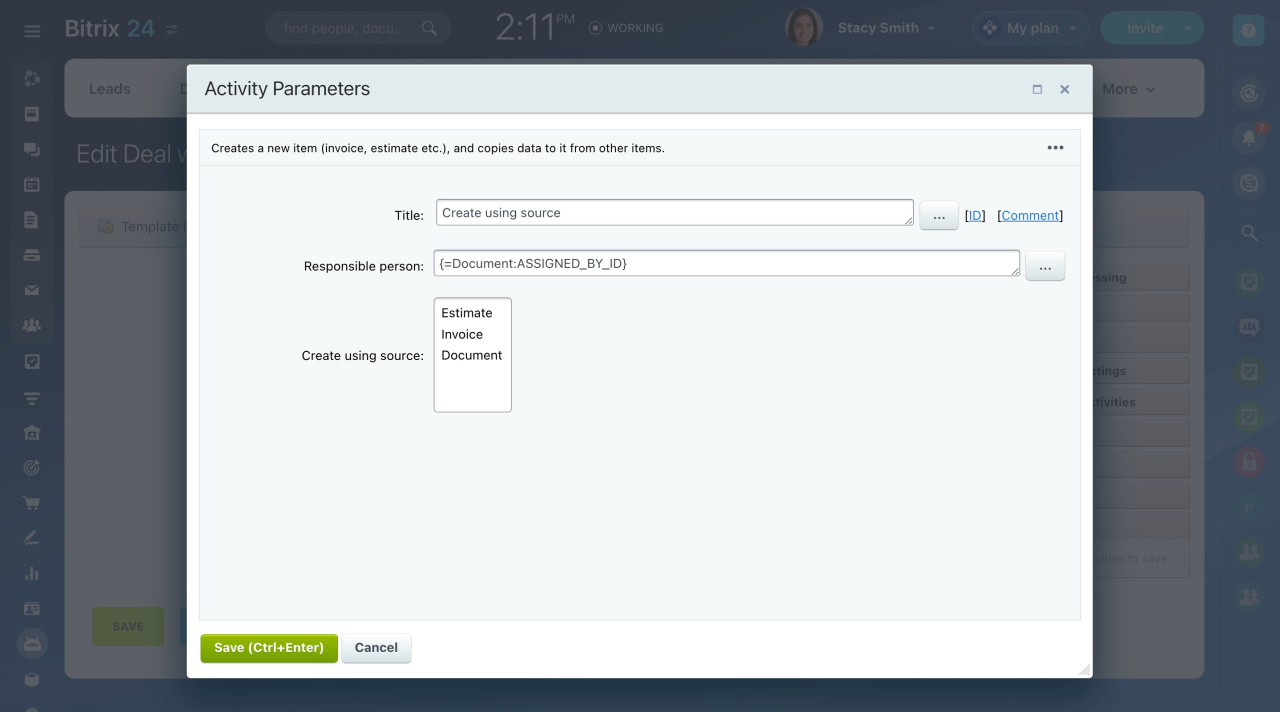
-
Responsible person: Assign a user.
-
Create using source: Choose what to create.
Delete CRM item
Deletes the selected CRM item.
Delete SPA
Deletes a Smart Process Automation item.
Delete product items
Removes all products from the CRM item.
Edit SPA item
Updates a Smart Process Automation item.
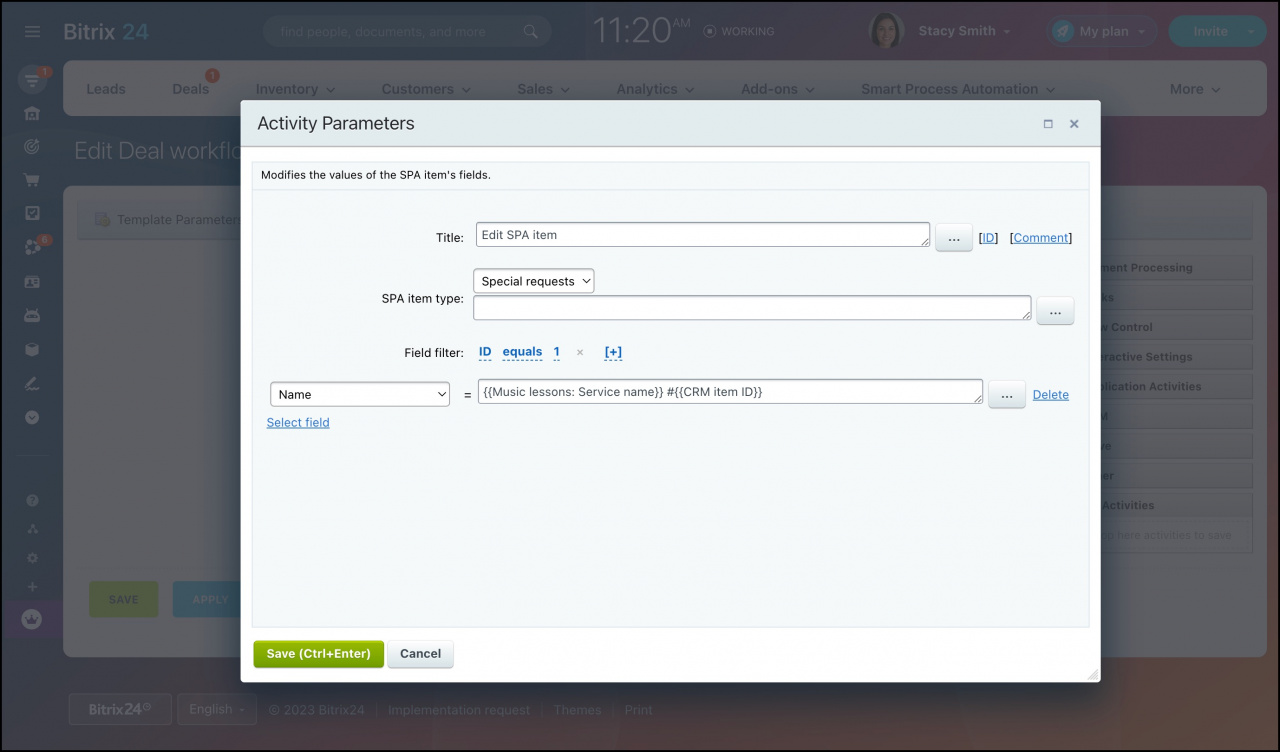
-
SPA item type: Select the type.
-
Field filter: Find the item using the filter.
-
Select field: Choose what to update.
End task
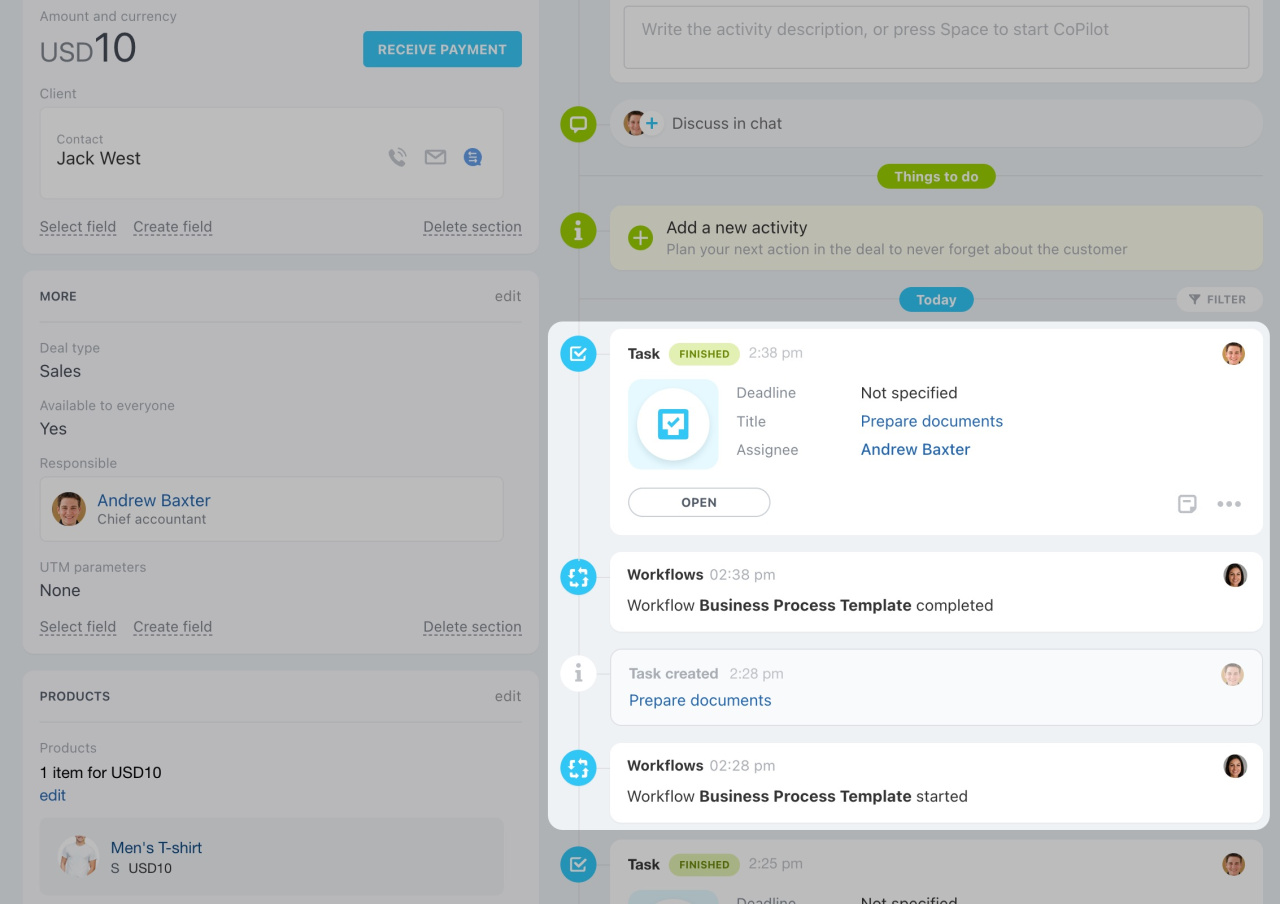
Completes tasks created during specific deal stages.
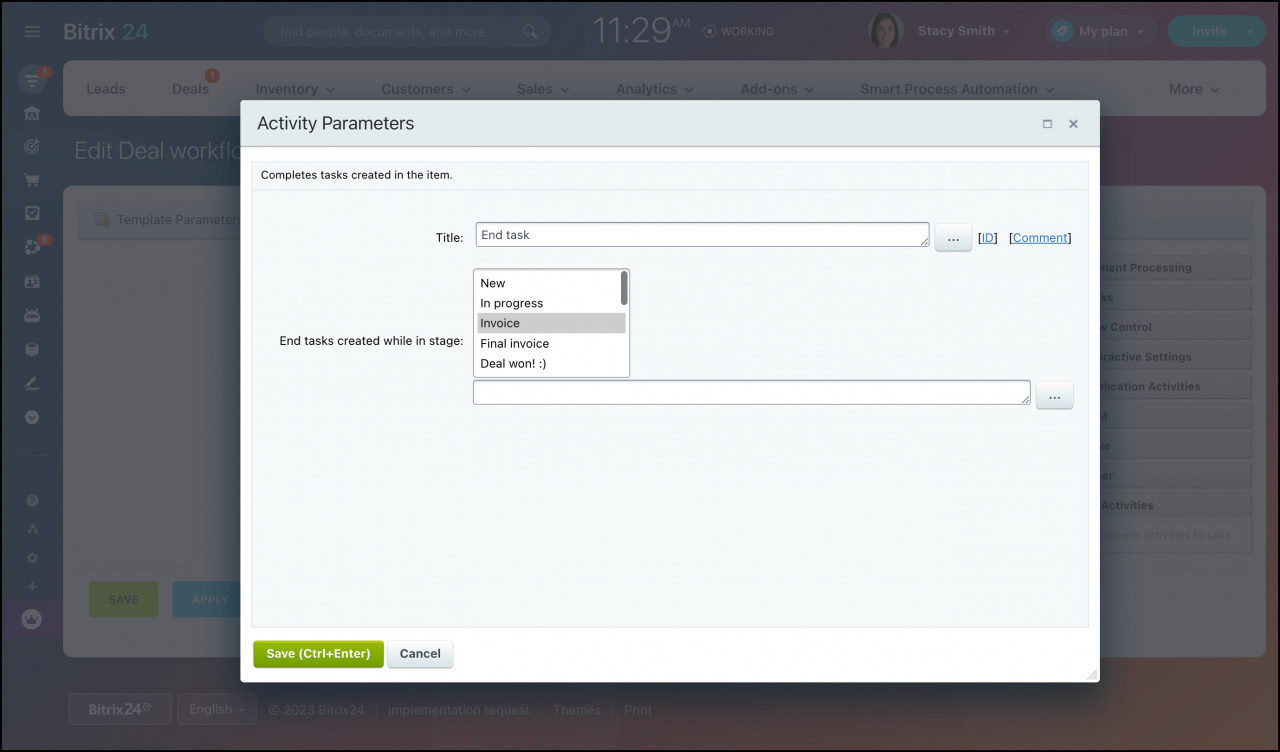
End tasks created while in stage: Select stages.
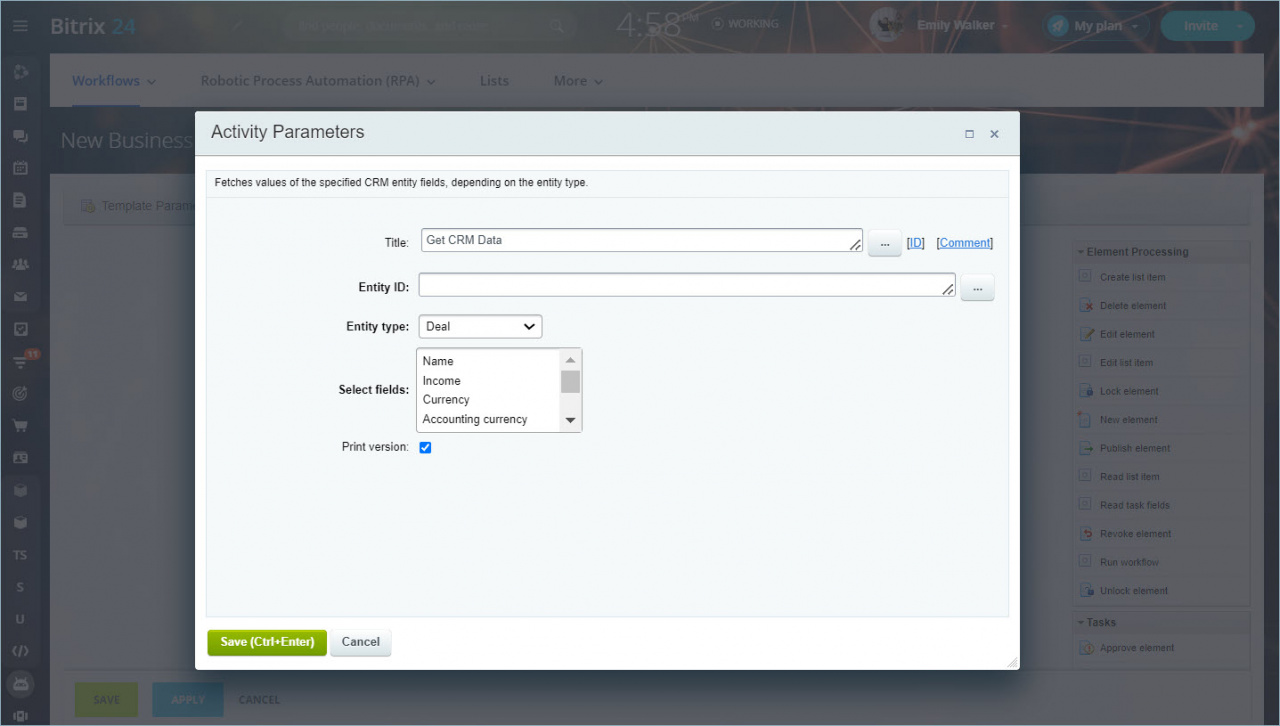
Get CRM Data
Retrieves field values from a CRM item.
-
Entity ID: Enter the item ID.
-
Entity type: Select contacts, leads, deals, or companies.
-
Select fields: Choose fields to retrieve.
-
Print version: Return formatted values.
Results are available for use in other workflow steps. You can find them in the Additional Results section of the Insert Value form.
Insert Value form
Get CRM item information
Finds a CRM item and returns selected field values.
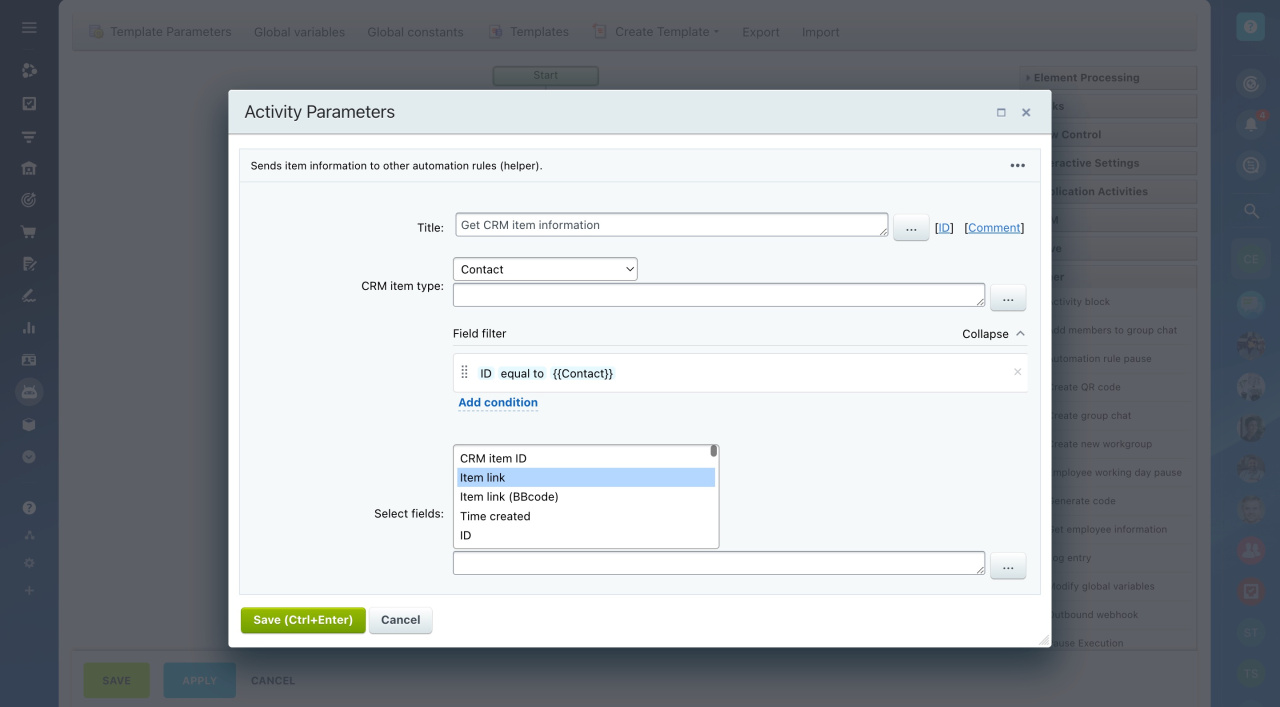
CRM item type: Select the item type.
Field filter: Set the search conditions. You can use the Insert Value form. If multiple records match, the system returns only the first one.
For example, you can filter by ID and match it to a specific item.
To get data from multiple records, use an iterator. If the values are stored in a multiple field or variable, pass the iterator value (from Additional Results) into the filter.
Learn more about using iterator
Select fields: Choose which fields to return. Available fields depend on the selected item type.
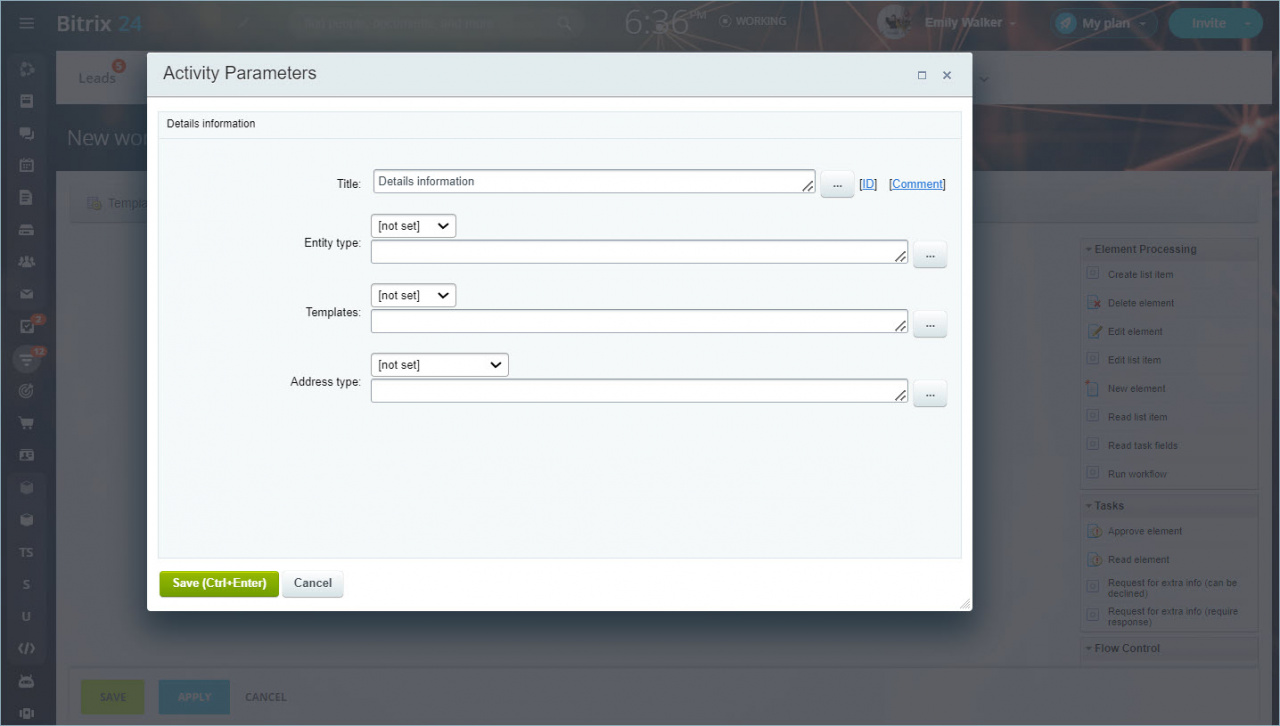
Get details values
Retrieves details for a contact or company.
- If you use this activity in a contact or company workflow, it returns details for that item.
- If you use it in a deal or lead workflow, it returns details from the linked contact or company.
-
Entity Type: Select contact or company. This option is not shown in contact or company workflows.
-
Templates: Choose a details template.
-
Address type: Select the address type to retrieve.
Get payment information
Returns payment status for an order.
Order ID: Enter the order ID.
Order processing in CRM
You can also use this activity to get the order payment ID.
Get product item information
Returns product data for use in other steps.
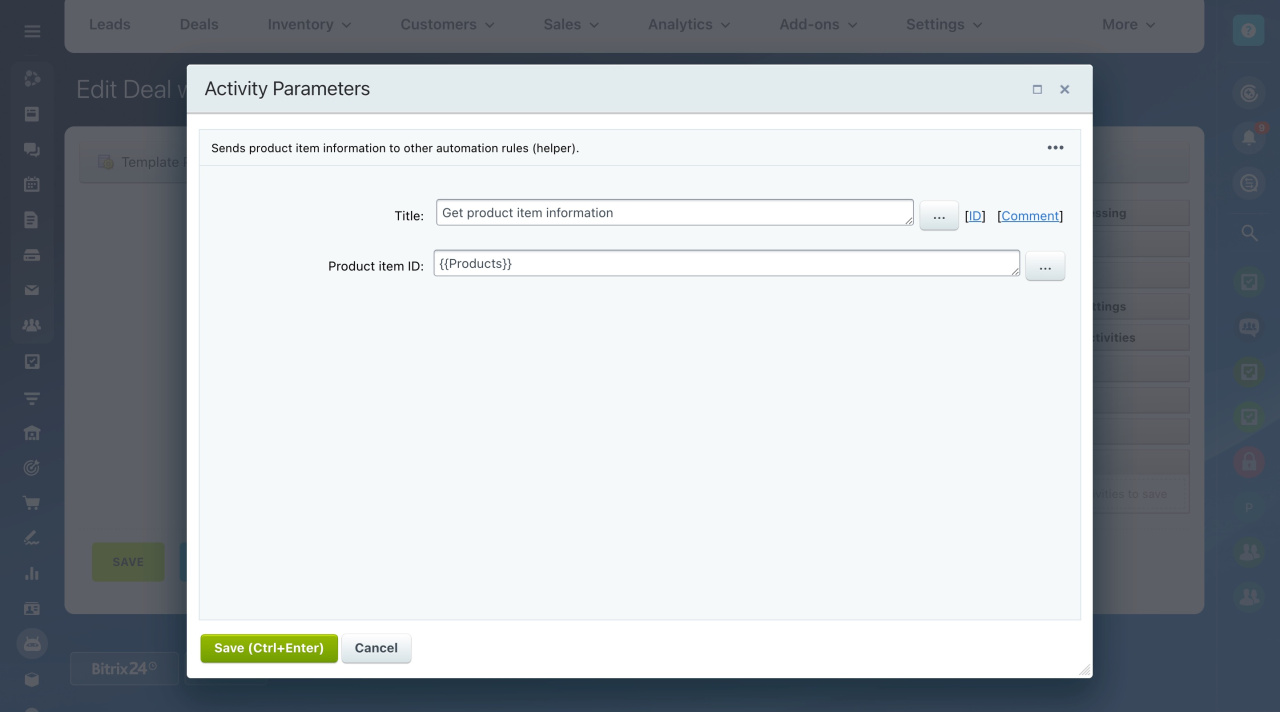
Product item ID: Enter the product ID.
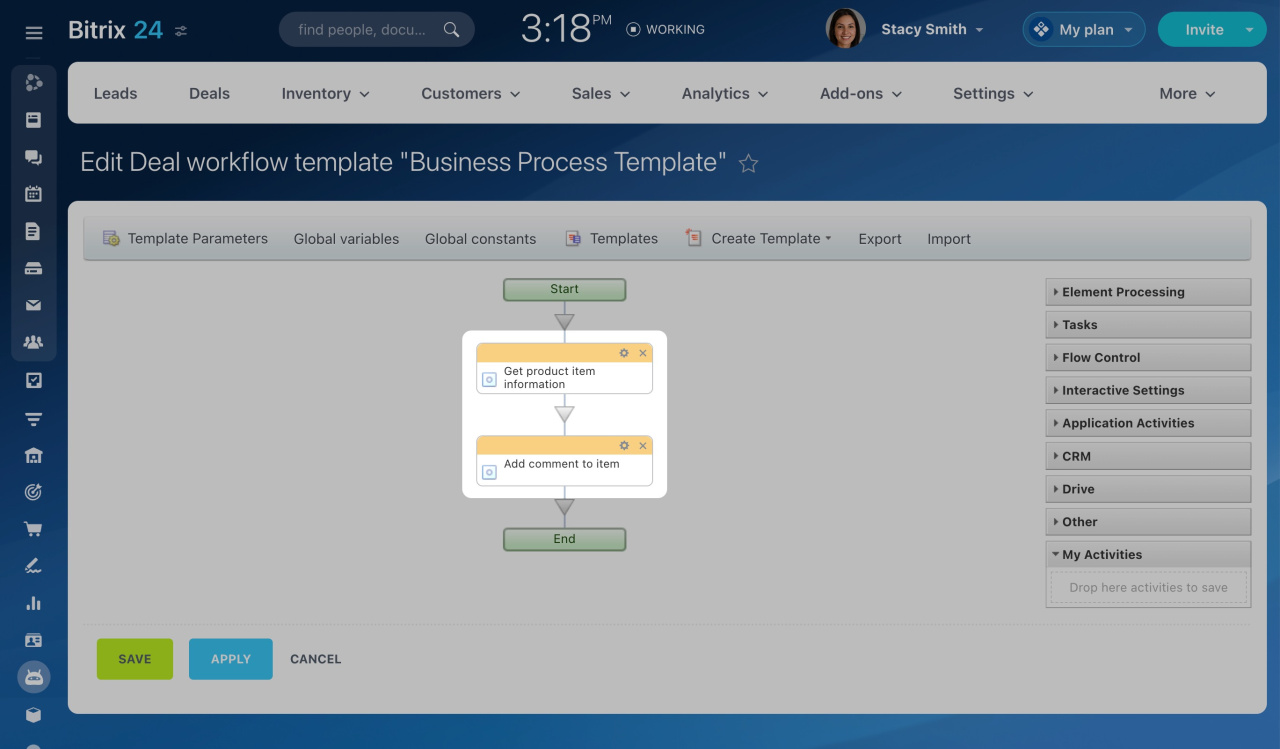
Example
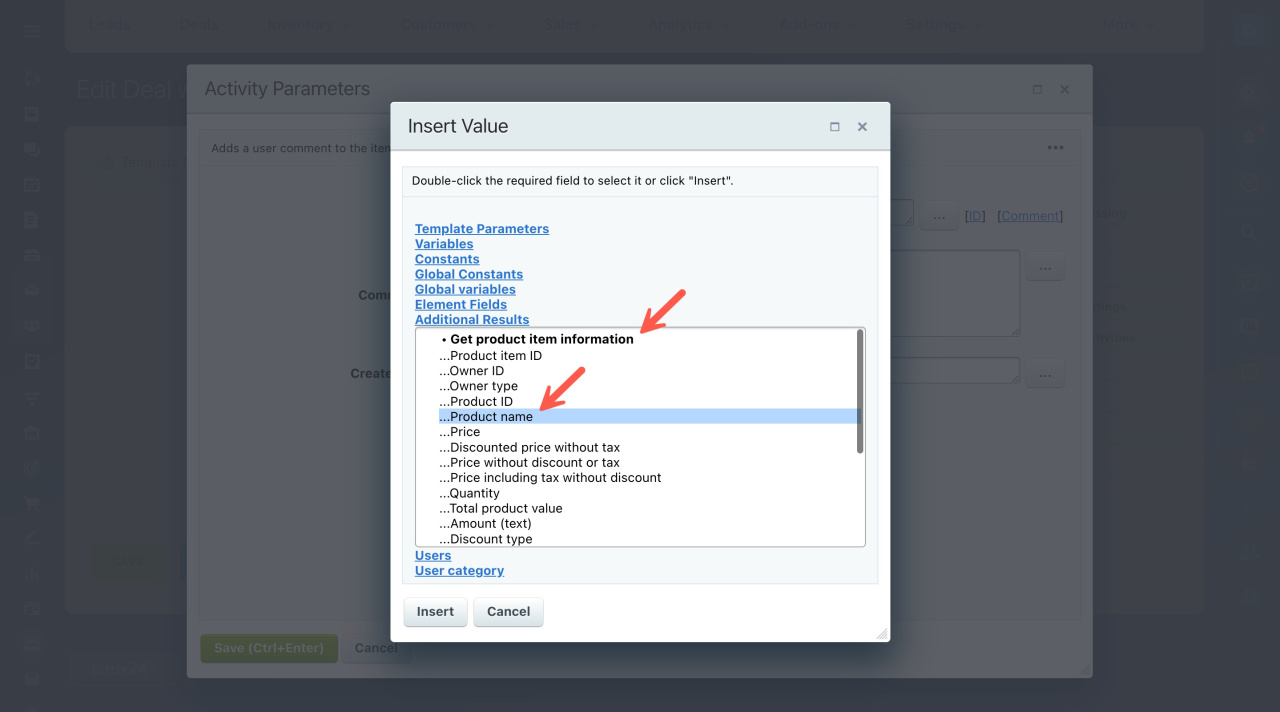
- In the Get product item information activity, enter the
{{Products}}parameter. - Use the Insert Value form to pass the product data to another step, such as Add comment to item.
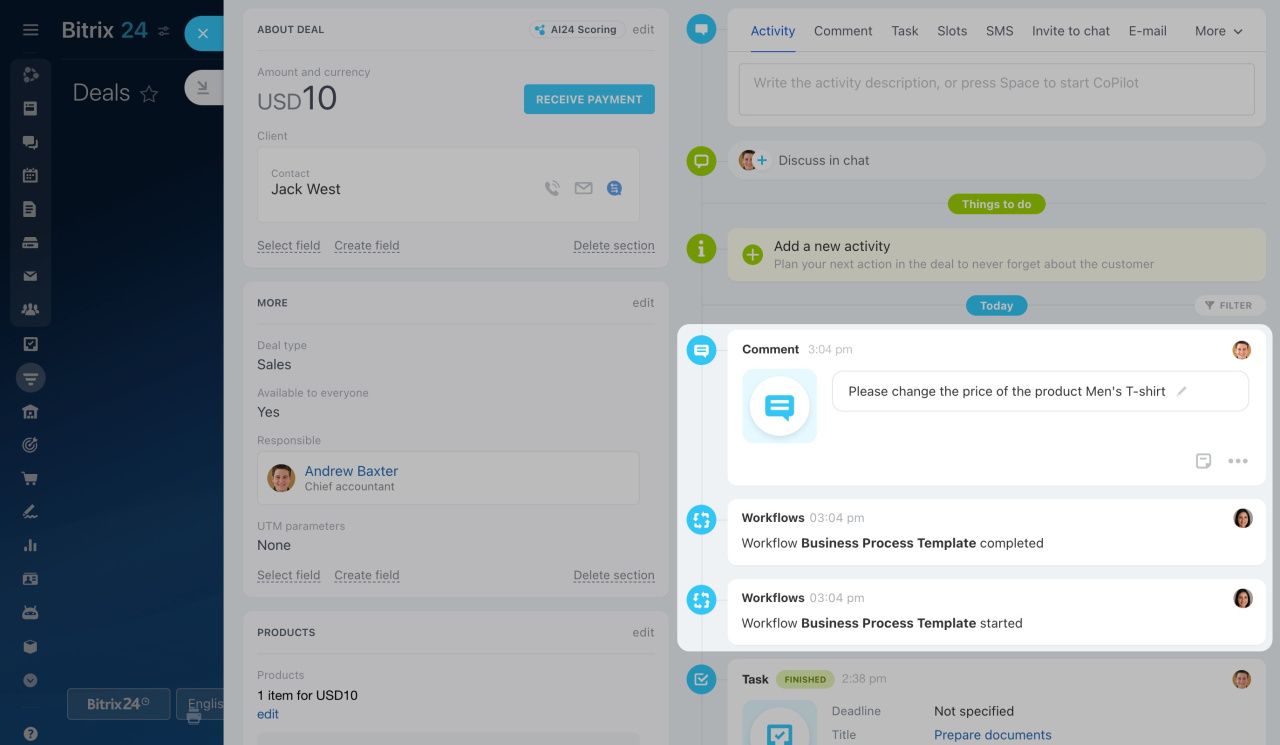
After the workflow runs, the system adds a comment with the selected product details.
Invite customer to messenger
Sends a Telegram invite link to the customer. Conversation history is saved in CRM.
Invite a customer to Telegram chat
Modify company
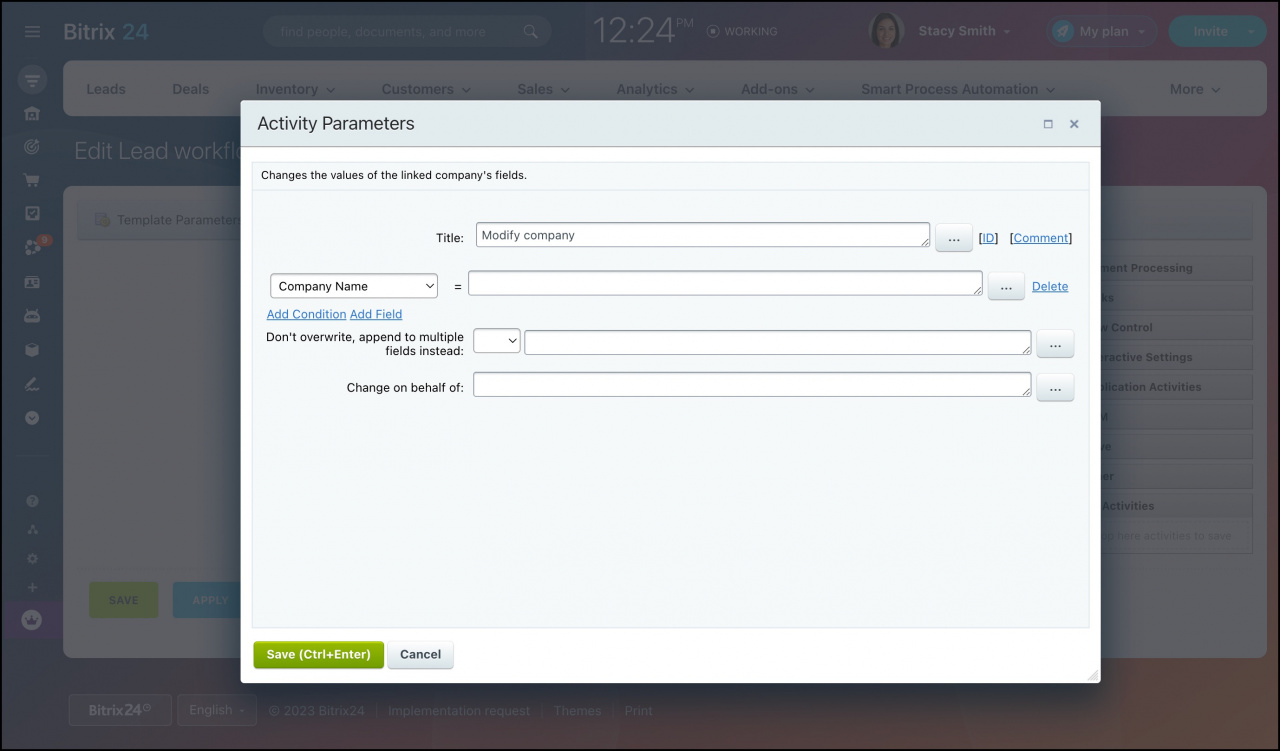
Updates fields in a linked company.
-
Add condition:Select fields and set new values.
-
Add field: Create a new field if needed.
-
Don't overwrite, append to multiple fields instead: Add values to multi-fields instead of replacing.
-
Change on behalf of: Select a user.
Modify contact
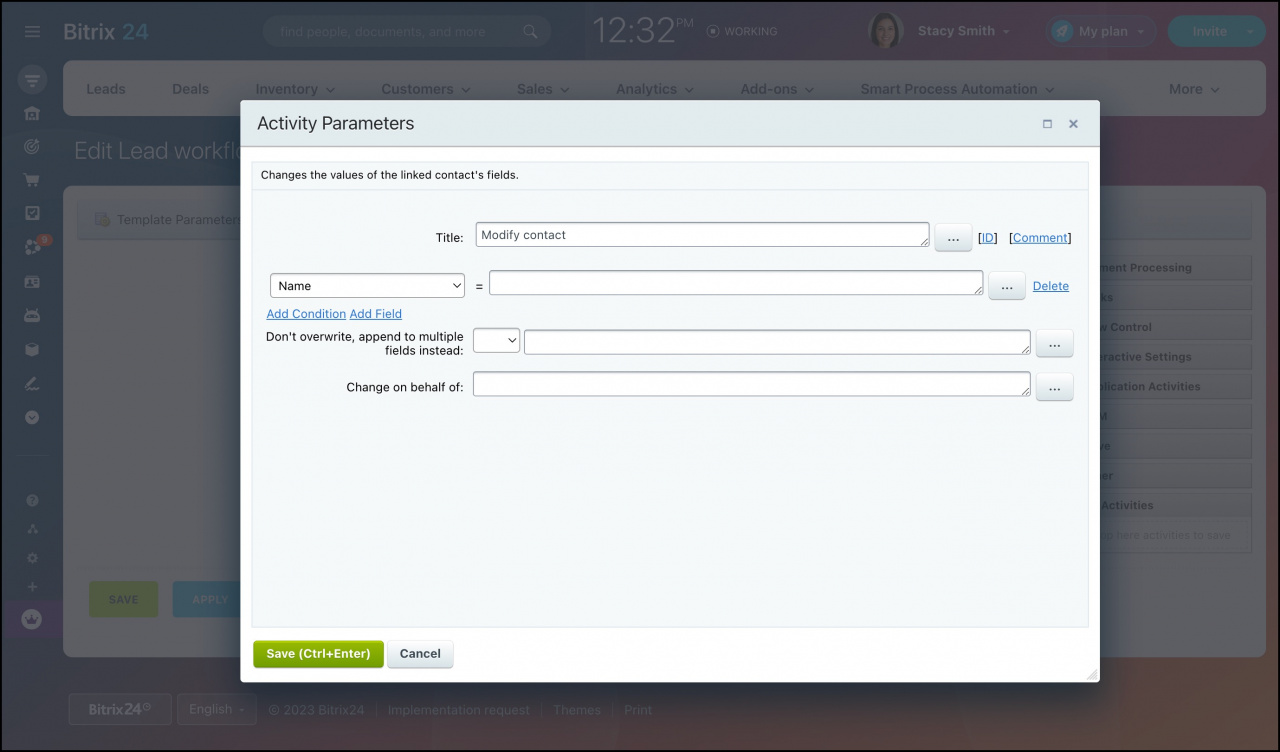
Updates fields in a linked contact.
-
Add condition: Select fields and set new values.
-
Add field: Create a new field if needed.
-
Don't overwrite, append to multiple fields instead: Add values to multi-fields instead of replacing.
-
Change on behalf of: Select a user.
Modify details
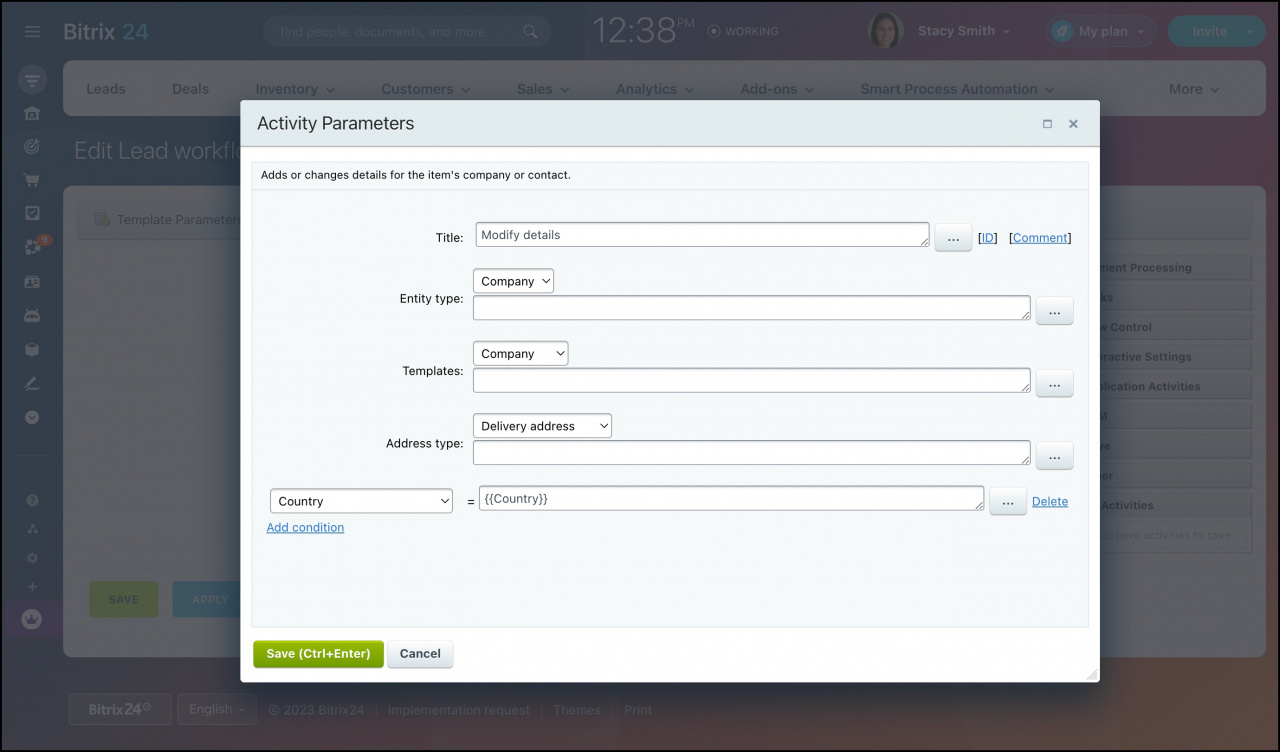
Updates contact or company details.
-
Entity type: Select contact or company.
-
Templates: Select a template.
-
Address type: Choose address type.
Pause
Pauses the workflow for a set time or until the customer responds.
Plan activity
Creates an activity for the responsible user.
-
Title: Enter a name.
-
Things to do: Add instructions.
-
Date: Set a deadline.
-
Responsible person: Assign a user.
-
Auto complete activity when status is updated: Marks the activity done when the stage changes.
Process automatic payment
Charges a customer automatically based on saved payment details (recurring payments).
Send SMS
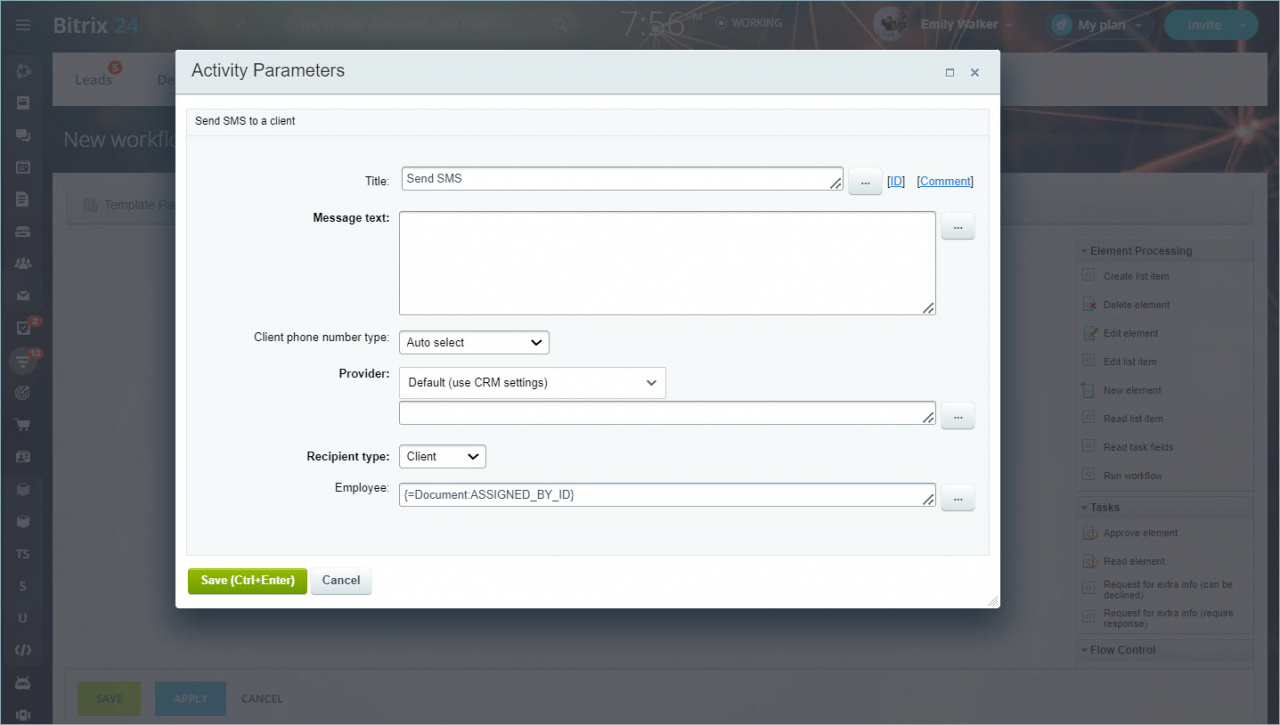
Sends an SMS message.
-
Message text: Enter the message.
-
Provider: Select an SMS provider. You can connect providers using the Bitrix24 Market apps.
-
Recipient type: Choose employee or client.
Schedule a call
Adds a call to the CRM item and the user’s calendar.
Schedule a meeting
Adds a meeting to the CRM item and the user’s calendar.
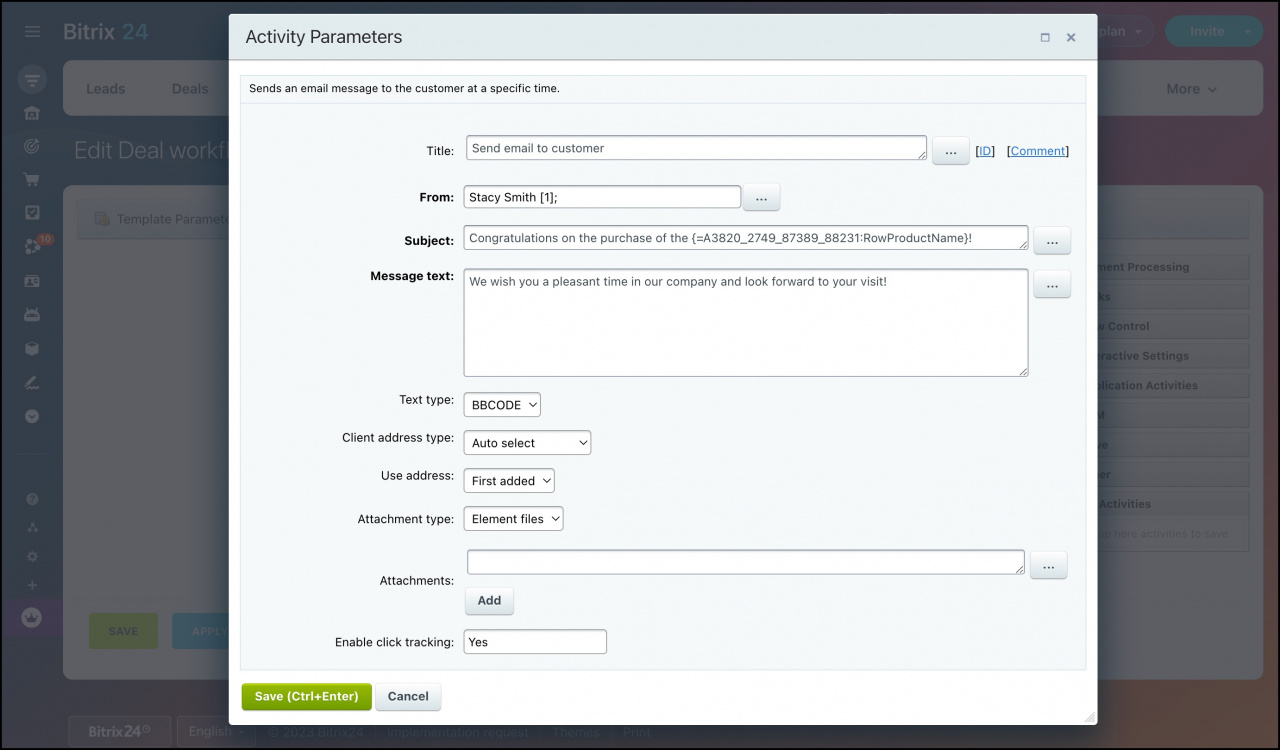
Send email to customer
Sends an email to a client.
Manage emails with CRM
-
From: Select the sender email address. The Auto select option uses the first connected mailbox. You can also connect a new email address.
-
Subject: Enter the email subject.
-
Message text: Enter the message content.
-
Text type: Choose BBCode or HTML.
-
Client address type: Select which email address to use. This is helpful if the client has multiple addresses.
-
Attachment type: Choose how to attach files.
- Document files: Attach files from a CRM field (you may need to create a custom File field).
- Drive: Attach files from Bitrix24 Drive.
-
Enable click tracking: Turn this on to track link clicks in the email.
Submit document for signing
Creates a document and sends it for signature.
Bitrix24.Sign in CRM
Waiting for deal stage
Pauses the workflow until a deal reaches a selected stage.
-
Deal ID: Enter the deal ID. You can use the Insert Value form.
-
Stage: Select one or more stages. The workflow waits until the deal moves to the selected or final stage.
If you use Waiting for deal stage in workflows triggered by updates, a new workflow starts each time the deal changes. Each one pauses and waits for the stage. When the deal reaches the selected stage, all of these workflows run at the same time.
Waiting for lead stage
Pauses the workflow until a lead reaches a selected stage.
-
Lead ID: Enter the lead ID.
-
Status: Select one or more stages. The workflow waits until the lead moves to the selected or final stage.